
It’s an age-old question that refuses to end: Is SEO dead? Whether it’s after a Google algorithm update, a viral tweet from a marketing “guru,” or the rise of a new AI tool, SEO seems to find itself under scrutiny time and time again. But here’s the truth: SEO isn’t dead, it’s just evolving faster than ever before. At Zero Gravity Marketing, we’ve seen every SEO panic cycle come and go. The tactics may change, but the core purpose of SEO (to help users find the most relevant content) remains. In fact, with the rise of AI Overviews, large language models (LLMs), and E-E-A-T (Experience, Expertise, Authoritativeness, Trust), SEO has never been more essential to digital strategy. So let’s explore what’s really happening in the world of SEO and what brands should do to stay competitive in the new search climate.
Is SEO Dead?
The short answer of, “Is SEO dead”: Absolutely NOT! SEO has had many hurdles and hoops to jump through since the inception of search engines. SEO has always been about evolution, from the introduction of featured snippets to adapting to the nuances of voice search. While the tactics and strategies have transformed, the foundational principle of optimizing for search engines remains essential.
Why People Keep Asking: Is SEO Dead?
There’s a reason this question keeps coming up: search is constantly changing. Google updates its algorithm thousands of times per year. New platforms emerge. Search result pages (SERPs) get cluttered with ads, featured snippets, videos, and AI-generated summaries. And now, tools like ChatGPT and Perplexity are reshaping how people research and make decisions. Each change triggers the same fear: “Will people still find my site?” And that’s a fair concern. But SEO isn’t dying, it’s diversifying. Today, SEO is no longer just about keyword rankings. It’s about visibility in a multi-platform, AI-driven world. Whether a user clicks a blog from Google, asks a chatbot for advice, or scrolls through product reviews on TikTok, your content still needs to be found, trusted, and acted upon. That’s the essence of modern SEO.
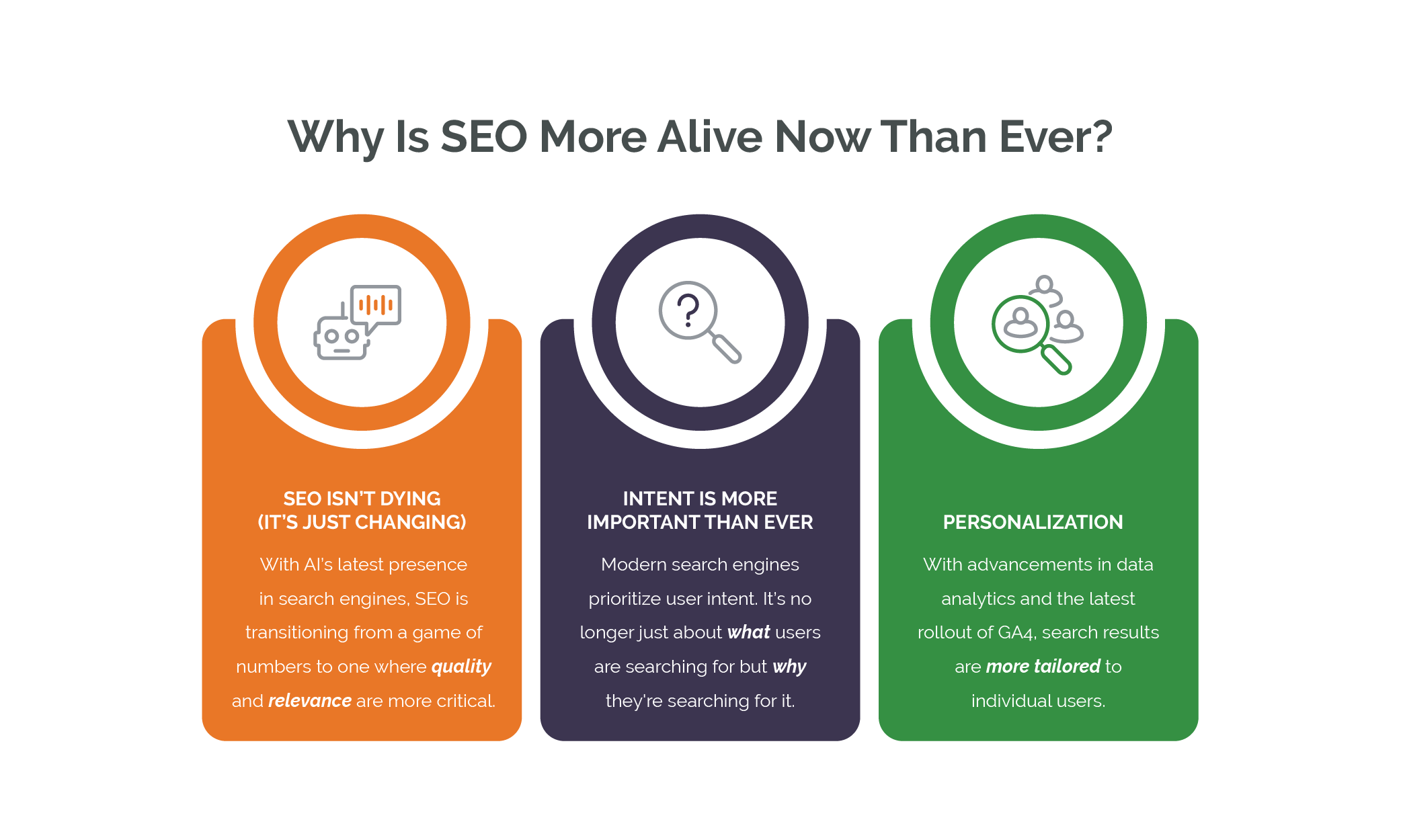
Why Is SEO More Alive Now Than Ever?
- SEO Isn’t Dying (It’s Just Changing): Like any active industry, SEO is in a state of fluctuation. With AI’s latest presence in search engines, SEO is transitioning from a game of numbers to one where quality and relevance are more critical. Organic SEO, which emphasizes genuine content and organic strategies, remains at the heart of the SEO evolution.
- Intent Is More Important Than Ever: Remember when keyword stuffing could guarantee high rankings? It’s no secret that things have changed, and this should not be your main strategy in your SEO efforts. Modern search engines prioritize user intent. It’s no longer just about what users are searching for but why they’re searching for it. This shift emphasizes the importance of creating fresh content that addresses users’ specific needs and queries.
- Personalization: With advancements in data analytics and the latest rollout of GA4, search results are more tailored to individual users. This personalization means businesses need a greater understanding of their audience’s preferences and behaviors to ensure their content appears in these bespoke search results. It’s important to dive deeper into your website’s analytics to understand the reasoning behind your results and change your digital marketing strategies accordingly to reach your intended audience better.
What Has Changed in SEO?
To understand why SEO is still alive (and thriving), we need to acknowledge how much it has changed. Long gone are the days of black-hat SEO tactics like stuffing keywords into low-effort blog posts or spamming backlinks to game the system. Google’s algorithm has matured significantly, rewarding websites that focus on user intent, high-quality content, and technical excellence. In recent years, updates like Helpful Content, Passage Ranking, and Core Web Vitals have emphasized the importance of creating content that’s truly useful. And now, AI has entered the picture, pushing digital marketers to think even more strategically.
AI Overviews: A New Layer of Competition
One of the biggest shifts in search is the introduction of AI Overviews (formerly known as Search Generative Experience or SGE) in Google Search. AI Overviews generate instant answers to queries using content pulled from high-ranking sources across the web. While these summaries may reduce click-through rates for some types of content, they also open up a new type of SEO opportunity: Answer Engine Optimization (AEO). Instead of simply optimizing for position #1, brands must now structure their content to be cited by AI, whether it appears in Google’s AI summary, a voice assistant response, or a chatbot result. This requires clear, direct, and well-sourced information that algorithms can trust and interpret. Want to optimize your site for AI Overviews? Start with on-page SEO, use structured data like schema markup, and format your content to answer common questions directly. We cover these techniques in more detail in our SEO services and content marketing strategy offerings.
What Are LLMs? Why Should Marketers Care?
Large Language Models (LLMs) like ChatGPT, Claude, and Gemini are quickly becoming how users find, evaluate, and interact with information. These tools summarize articles, compare options, and even recommend products-all without ever clicking on a traditional search result. So, is SEO dead because users are no longer searching the “old” way? Not at all. But LLMs are redefining what it means to be visible online. If your content is hard to parse, buried in fluff, or lacking authority signals, it’s unlikely to be cited or recommended by an AI. To be surfaced by LLMs:
- Write in a clear, structured format
- Use citations and data where appropriate
- Establish topical depth with interconnected content clusters
- Demonstrate credibility and originality
This is where your content creation strategy and technical SEO efforts must work in harmony.
E-E-A-T: Your Brand’s Trust Signal in an AI World
With all the noise on the web, how do AI systems and users know who to trust? That’s where E-E-A-T (Experience, Expertise, Authoritativeness, and Trustworthiness) comes in. While not directly a ranking factor, E-E-A-T is baked into Google’s guidelines for evaluating quality content. It’s also increasingly influencing what information LLMs choose to summarize and cite. Here’s how to improve your E-E-A-T signals:
- Add author bylines with credentials
- Include “About” pages that build company trust
- Link to reputable sources
- Display real-world experience in your content (case studies, tutorials, firsthand reviews)
We’ve helped countless clients strengthen their digital authority through strategic content, reputation management, and site architecture. Learn more about our full-service approach here.
What Is the Future of SEO?
When it comes to the SEO industry and whether implementing an SEO strategy should still be a top priority for your brand, the simple answer is yes! The future of SEO is promising, and while AI will, without question, influence search algorithms, it won’t take away from the need for SEO. Instead, it will refine and redefine it, making it more important than ever to keep on top of your strategy. The emphasis will increasingly shift towards understanding user behavior, deciphering intent, and delivering personalized user experiences. For a comprehensive understanding of how SEO is shaping up and strategies to utilize, explore these SEO ranking tips.
Frequently Asked Questions:
Is SEO a dying industry?
Far from it. While SEO is evolving, it remains an important strategy to incorporate into your digital marketing efforts. It’s pivotal for driving organic search traffic, enhancing brand visibility, and building credibility in the online space.
Why should I continue to do SEO?
Beyond driving organic traffic, SEO offers invaluable insights into user behavior, market trends, and competitive landscapes. It’s a tool that, when wielded right, can significantly boost return on investment (ROI). Dive deeper into crucial SEO metrics to understand its multifaceted benefits.
How has SEO evolved?
From the early days of simple keyword matching to today’s complex algorithms that consider user intent, voice search, AI predictions, and more, SEO has consistently evolved to meet the demands of a changing digital ecosystem.
In Conclusion: SEO’s Resilient Journey
When it comes to SEO, its story is certainly not over. As search engines evolve, so does SEO, and its resilience and adaptability show the constant effort to bridge users with the information they seek. To navigate this ever-changing landscape and ensure your business remains ahead of the competition, reach out to Zero Gravity Marketing for expert insights and guidance in order to reach your ultimate goal.