


The attention economy has changed by becoming more crowded and realigning how audiences filter or engage with marketing.
As enrollment leaders navigate attention marketing trends in 2026, what worked before is rapidly becoming obsolete. With audiences now having total control over what they see, campaigns can no longer revolve around purchase exposure alone.
To truly remain competitive, enrollment leaders must design campaigns around earning attention. Leaning into generative engine optimization, SEO, and other inbound marketing strategies goes a long way in today’s attention economy.
At ZGM, we now acknowledge creative, sequencing, frequency, and contextual targeting as vital campaign components. Understanding this begins with knowing why the attention economy is on a rapid trajectory change.
Why Has the Attention Economy Reached an Inflection Point?
The attention economy has reached an inflection point because the conditions for earning attention are fundamentally changing.
Going into 2027, media consumption is increasingly fragmented, with short-form content and constant scrolling becoming standard practice. Likewise, feeds are now algorithmically curated. Because of these changes, audiences have become prone to skipping, scrolling past, or ignoring advertisements.
With rapid changes underway, the attention marketing trends in 2026 point to an undeniable inflection point: enrollment leaders aren’t necessarily struggling to reach prospective students. However, they are struggling to make students pause, process, and remember ad messaging.
Institutions also face significant competition in the intent economy marketing space. Traditional reach-and-frequency thinking no longer converts when universities compete not just against other schools, but other content in students’ media environments.
Far too many leaders rely upon outdated enrollment marketing strategies that no longer reflect audience behavior. Fixing this requires studying attention marketing trends in 2026, then dissecting today’s prospective student media behavior.
What Does Prospective Student Media Behavior Actually Look Like in 2026?
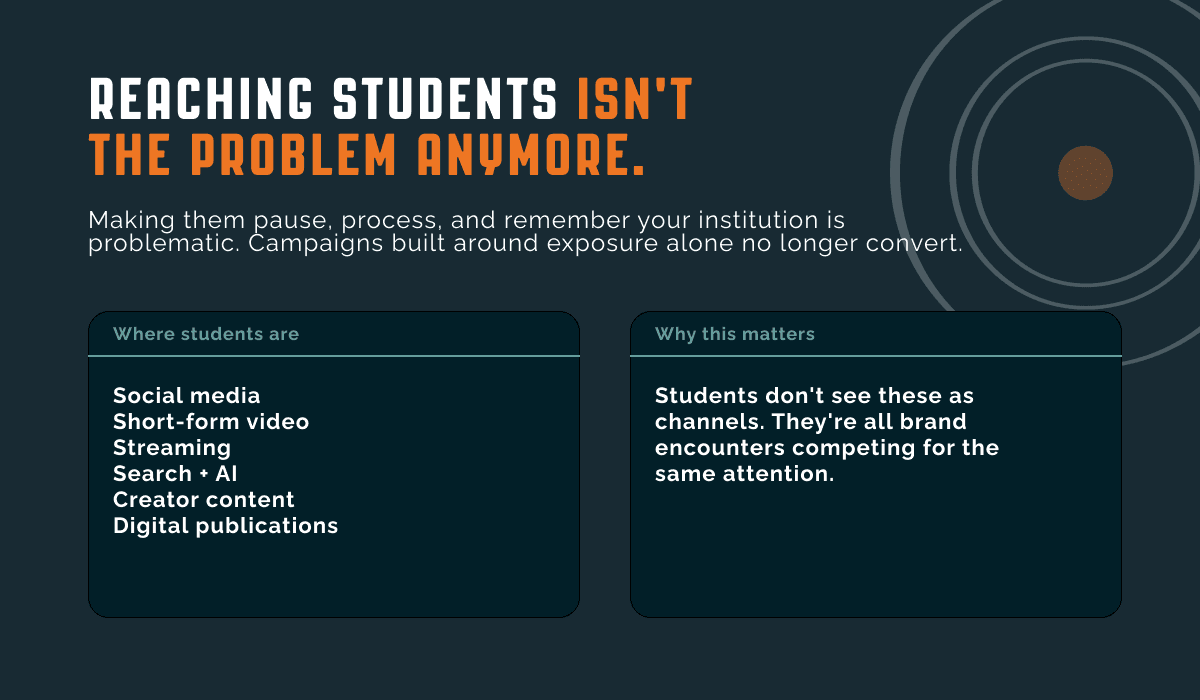
In 2026, prospective student media behavior looks like young people absorbing information via six primary forums: social media, short-form videos, streaming, search, creator content, and digital publications/websites.
More often than not, students don’t consciously view these forums as “separate channels.” Rather, they’re interpreted as brand encounters, each one happening in different contexts, thus competing for attention.
Amid evolving prospective student media behavior, marketers should adapt accordingly. Consider partnerships with popular online influencers who push creator-driven content. ROI here doesn’t just fuel student yield. It also helps you increase exposure while optimizing attention marketing trends in 2026.
What is the Attention Economy?
The attention economy is a market where institutions compete for audience attention as these audiences navigate an overabundance of content and messages.
Why Does Bought Attention Need to Become Earned Attention?
Bought attention needs to become earned attention because awareness in isolation doesn’t drive student yield.
That’s further underscored by attention marketing trends in 2026. Case in point: students remembering, understanding, and developing interest in a university often precedes enrollment.
Selecting a program or institution also requires meaningful consideration. Therefore, while bought attention remains necessary for scale and reach, earned attention is often the impetus that drives conversion.
While navigating intent economy marketing, enrollment leaders should avoid treating impressions as equivalent to meaningful attention.
| Bought Attention | Earned Attention |
|---|---|
| Secures exposure | Encourages engagement |
| Driven by media investment | Driven by relevance and creative |
| Creates an opportunity to be seen | Creates an opportunity to be remembered |
| Measures delivery | Considers impact |
What Makes Creative Break Through in a Filtered World?
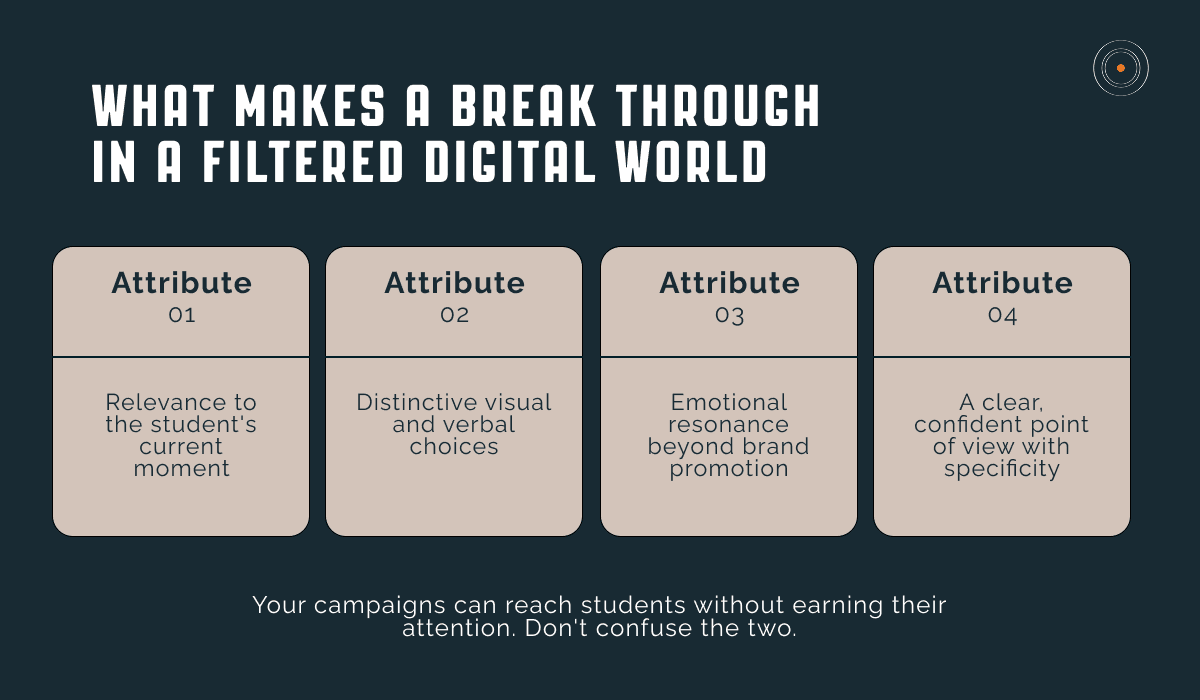
In a filtered world, there are five characteristics that make creative break through: specificity, relevance, distinctive visual/verbal choices, emotional resonance, and a clear point of view.
Like generative engine optimization, SEO, and other marketing, creative has become part of the attention strategy, rather than the final expression of a media plan. As time goes on, prospective students naturally become more adept at screening out familiar advertisements.
This means the days of generic higher ed messaging are over. For creative to break through moving forward, it needs to be well-targeted, while giving audiences a real reason to pay attention.
How Should Enrollment Marketers Rethink Frequency, Sequencing, and Context?
Enrollment marketers should rethink frequency, sequencing, and context by approaching exposure more strategically and leaning into programmatic use. This fosters across-the-board campaign optimization, while also ensuring everything aligns with attention marketing trends in 2026.
Mastering frequency isn’t about repeatedly showing audiences the same message. It’s about making sure that each exposure delivers new, worthwhile information.
In today’s intent economy marketing landscape, sequencing also calls for more prudence. The first encounter is where enrollment leaders earn attention. Subsequent encounters are about building relevance, understanding, credibility, and consideration.
Then comes context. It matters where your ads actually appear. Enrollment leaders must do more than merely find the right audiences. They should likewise reach audiences in environments where institutional messaging is contextually relevant.
StackAdapt is exceptional for this. Uniquely positioned for contextual targeting, this programmatic tool helps place messages alongside content that’s already captured audience attention.
When enrollment marketers leverage StackAdapt’s platform, they’re ensuring their ads reach prospective students who are already engaged and receptive. Long-term, this approach can prove beneficial to institutional yield rates.
What Would Change If Enrollment Marketing Were Built Around Attention First?
If enrollment marketing were built around attention first, universities could eliminate many obstacles to greater student yield.
Reducing unnecessary friction is bigger than understanding attention marketing trends in 2026. It demands a broader shift that makes attention, sequencing, intent-aligned audiences, and integrated creative/media strategies the new baselines.
Barring adaptation to changes in the attention economy, your campaigns could technically reach prospective students without making the necessary impressions.
Moving forward, enrollment leaders must know not only whether their marketing reaches audiences, but also whether it gives audiences a reason to pay attention.
Source: Inside Higher Ed
Amid years of partnering with higher ed marketers, we intrinsically know how creative, media, and context influence audience behavior. Talk to ZGM today about a modern enrollment marketing strategy built for how attention actually works.