

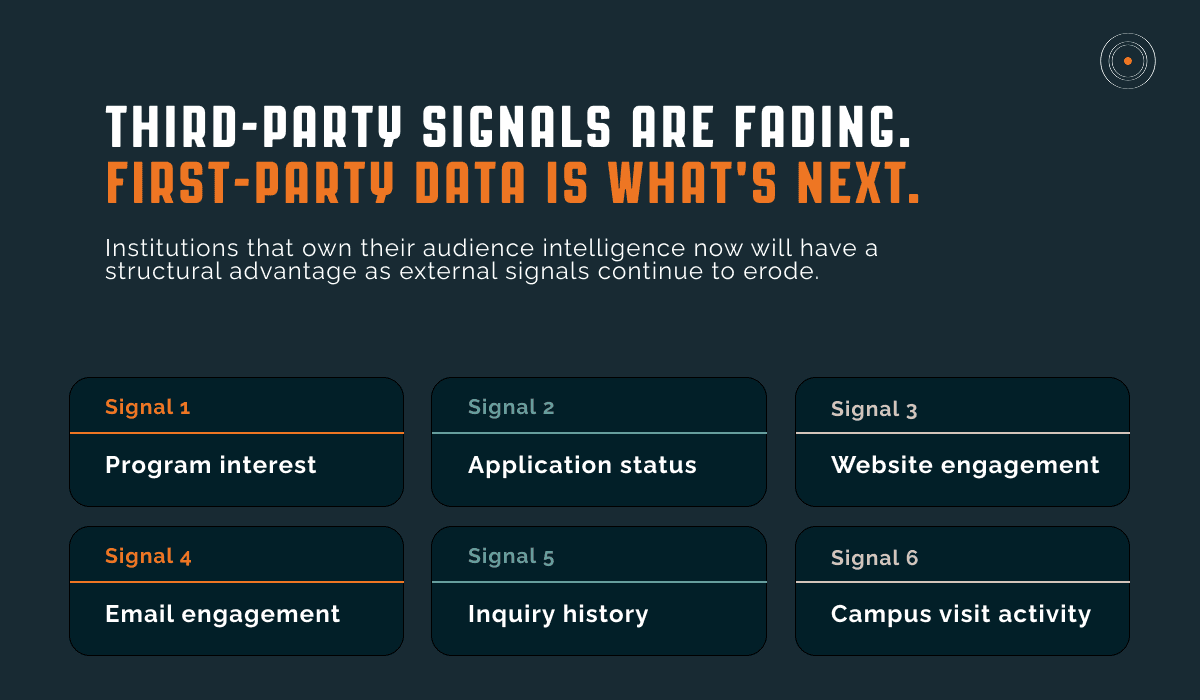
First-party data is the next enrollment marketing competitive advantage because third-party targeting signals are becoming less dependable. This shift (along with projected higher education marketing trends in 2027) opens a clear path for institutions’ next steps.
Step one is using data to build more durable audiences for targeting, retargeting, lookalikes, and suppression. Whether powered by CRM records, inquiries, websites, or email engagement, an effective first-party data strategy for higher ed is no longer optional.
Connecting this data to campaign activation should happen sooner rather than later. Amid the evolving digital advertising landscape, universities that act ahead of competitors are likely to see higher student yield.
What Is Happening to Third-Party Targeting and What Comes Next?
Cookie depreciation is rapidly happening to third-party targeting. What comes next is a necessary shift where enrollment campaigns stop relying on external signals and start understanding target audiences.
On multiple fronts, this reinforces the right first-party data strategy for higher ed. Right out of the gate, enrollment journeys are long and fragmented, leaving many variables.
Then, prospects interact across multiple outlets.
From websites, forms, and emails to events, search, social, and paid media, each channel offers valuable intent signals that institutions can’t afford to miss. At ZGM, we’ve consistently seen that signal loss undermines precise audience targeting/measurement. While first-party data supports optimal student enrollment marketing strategies, it doesn't automatically replace third-party signals. Instead, this data gives universities stronger audience intelligence from established relationships and interactions with prospective students.
According to HubSpot, leveraging first-party data makes marketers 93% more likely to report that their teams outperformed set goals.
What Does First-Party Data Actually Look Like in Higher Ed Enrollment Marketing?
In higher ed enrollment marketing, first-party data looks like information gathered via engagement with prospective students.
Likewise, leaning into a first-party data strategy for higher ed isn’t just about more data. It’s about connecting intent signals with data so that marketers know (and act upon) prospective students’ current placement in the enrollment journey.
Given the projected higher education marketing trends in 2027, there are seven intent signals for institutions to weigh heavily:
- Program interest
- Inquiry history
- Application status
- Website engagement
- Email engagement
- Event/webinar participation
- Campus visit activity
Be aware: your first-party data strategy for higher ed should not mistake data sitting in a CRM for data that can be activated in marketing. In fact, CRM data, when handled properly, holds intent signals that institutions should use to streamline active channels in real time.
What is First-Party Data?
First-party data is information collected by an institution via interactions with prospective students.
How Can CRM Data Power Smarter Programmatic Campaigns?
CRM data can power smarter programmatic campaigns by fueling media activation. This then boosts campaign engagement, which subsequently fosters new audience intelligence.
At this stage, institutions have to know that programmatic campaigns align with an optimal first-party data strategy for higher ed. Take StackAdapt, for instance. Through lookalike audiences, retargeting, and suppression, this platform directly activates CRM lists.
These lists then open a clear runway to find additional audiences with similar characteristics or behaviors, thus boosting student yield potential.
By also re-engaging individuals with prior history, institutions can secure greater ROI from programmatic campaigns. Pursuant to this, StackAdapt also helps exclude inactive or already-enrolled audiences.
| Traditional targeting | First-party activation |
|---|---|
| Relies more heavily on external signals | Uses institution-owned audience data |
| Broad audience definitions | Known prospect and engagement signals |
| Less institutional context | Connected to CRM/enrollment context |
| Vulnerable to changes in external signals | Built around data the institution controls |
Why Does First-Party Data Become More Valuable Over Time?
First-party data becomes more valuable over time because it quickly compounds. Understanding how it compounds supports a first-party data strategy for higher ed with strong ROI.
With better data, institutions can access more relevant audiences. This consequently fuels smarter campaigns with higher engagement and better outcomes. Over time, these advantages yield richer data overall.
Moving forward, institutions should integrate this data flywheel into their student enrollment marketing strategies. It’s a game-changer because successfully marketing similar programs to recurring audiences across cycles maximizes student yield.
When optimizing your first-party data strategy for higher ed, don’t forget that more data doesn’t automatically produce better marketing. Quantity alone also won’t confer value. Rather, clean, connected, permissioned, and actionable data is what really moves the needle.
All in all, universities that build this infrastructure now become best-placed for more valuable data across enrollment cycles later.
How Can Enrollment Marketers Start Building First-Party Data Infrastructure This Cycle?
Enrollment marketers can start building first-party data infrastructure this cycle by assessing inventory, priority audiences, activation, governance, and measurement. These core pillars remain inseparable from a first-party data strategy for higher ed that actually converts.
For optimum infrastructure, your team should be able to answer the following questions:
- What prospect and engagement data already exists, and where does it live?
- Which audiences would be most valuable to activate first?
- Can CRM data connect securely to programmatic and other media channels?
- Are consent, data quality, refresh frequency, and enrollment outcomes being considered?
Don’t fall into the trap of waiting for a perfect, enterprise-wide solution.
Instead, start with one high-value audience or campaign. This doesn’t just fortify your first-party data strategy for higher ed. The pilot and scale approach also helps stress-test your system and uncover hidden gaps before they drain your budget.
What Should Enrollment Leaders Be Asking Now?
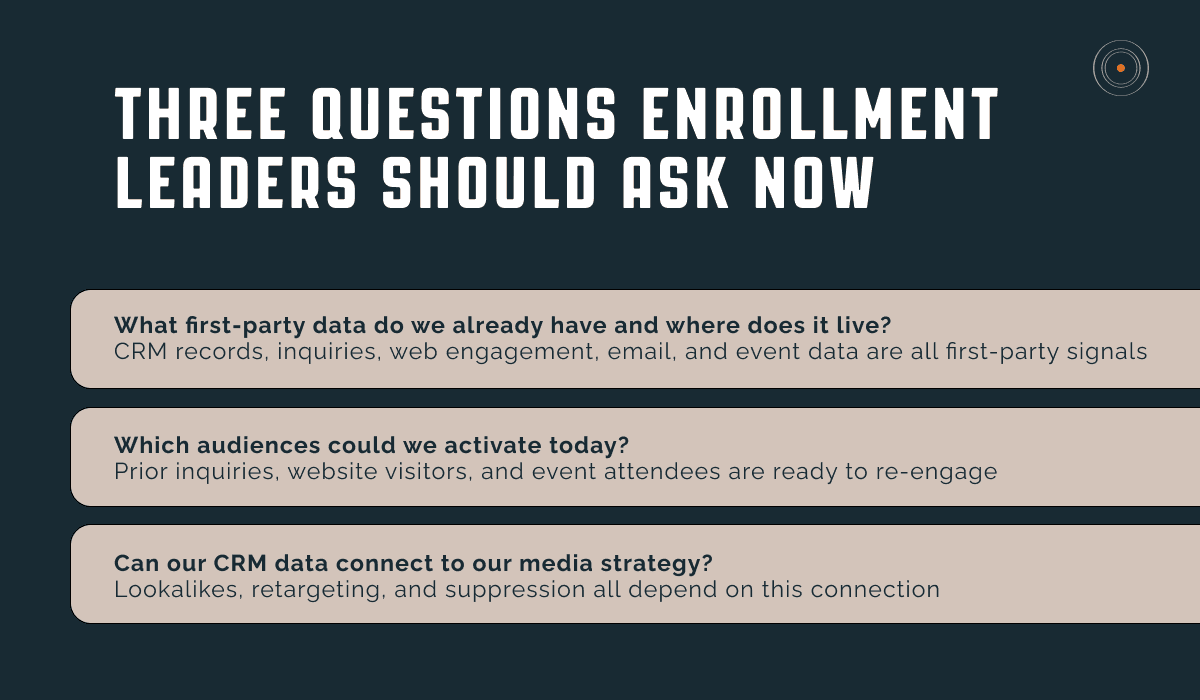
Enrollment leaders should now be asking questions that focus on strategic media execution and feedback loops.
Institutions with effective student enrollment marketing strategies don’t limit themselves to first-party data in isolation. Conversely, they ensure that this data remains connected and usable while facilitating engagement with prospective students.
To streamline operations, enrollment leaders should ask teams five core questions:
- What first-party data do we already have?
- Which audiences could we activate today?
- Can our CRM data connect to our media strategy?
- Are we using retargeting, lookalikes, and suppression effectively?
- Can campaign outcomes improve the data we use in the next enrollment cycle?
What Does This Shift to First-Party Data Mean For the Future of Enrollment Marketing?
For the future of enrollment marketing, this shift to first-party data means new targeting tactics alone will no longer confer competitive advantages. Instead, institutions must ensure their data generates actionable audience intelligence. This is now a requirement to optimize a conversion-friendly, first-party data strategy for higher ed.
You don’t have to build the full-state infrastructure today. However, you should know your current first-party data, what it can activate, and whether its content aligns with high student yield.
Source: ResearchGate
Amid years of partnering with higher ed enrollment leaders, we’re proud to help institutions connect data, media, targeting, and yield rate. Ask ZGM today how to activate your first-party data for smarter enrollment campaigns.