


Leaving graduate and adult learner revenue on the table is a strategic blind spot for universities because these demographics offer major enrollment opportunities. Yet, despite graduate and adult learner enrollment trends in 2026, many universities only market to them with tactics suited for traditional undergraduates.
Optimizing graduate student recruitment strategies is bigger than just “demographic targeting.” These prospects come with their own unique motivations, decision timelines, media behaviors, and informational mandates.
Heading into 2027, institutions must be cognizant and adapt accordingly if they’re serious about higher education revenue diversification. Simply adjusting the creative isn’t enough.
Moving forward, we’ll assess why universities should rethink their target audiences, messages, and mediums to align with graduate and adult learner enrollment trends in 2026.
What Is the Graduate and Adult Learner Revenue Opportunity Universities Are Missing?
Program-level marketing is the graduate and adult learner revenue opportunity that universities are missing. Plugging the gap means pivoting towards stackable credentials, student demand, and campaign performance gains.
Many universities already hold significant capacity and revenue potential for graduate/adult students. Yet, limited certificate offerings, misaligned programs, and subpar campaigns are holding them back.
There’s a difference between having a market vs. effectively reaching that market. Institutions frequently struggle with the latter. This then complicates higher education revenue diversification while undermining adult and graduate student recruitment strategies.
At ZGM, we see a clear remedy. Universities must transition from viewing the program as problematic to instead looking at the audience, context, and propositions that drive marketing.
If your graduate or adult programs are underperforming or misaligned with adult learner enrollment trends in 2026, interrogate the marketing brief.
What is an Adult Learner?
An adult learner is a student balancing their education with professional, financial, familial, and/or other life responsibilities.
Why Does Traditional Enrollment Marketing Fail the Graduate and Adult Learner Audience?
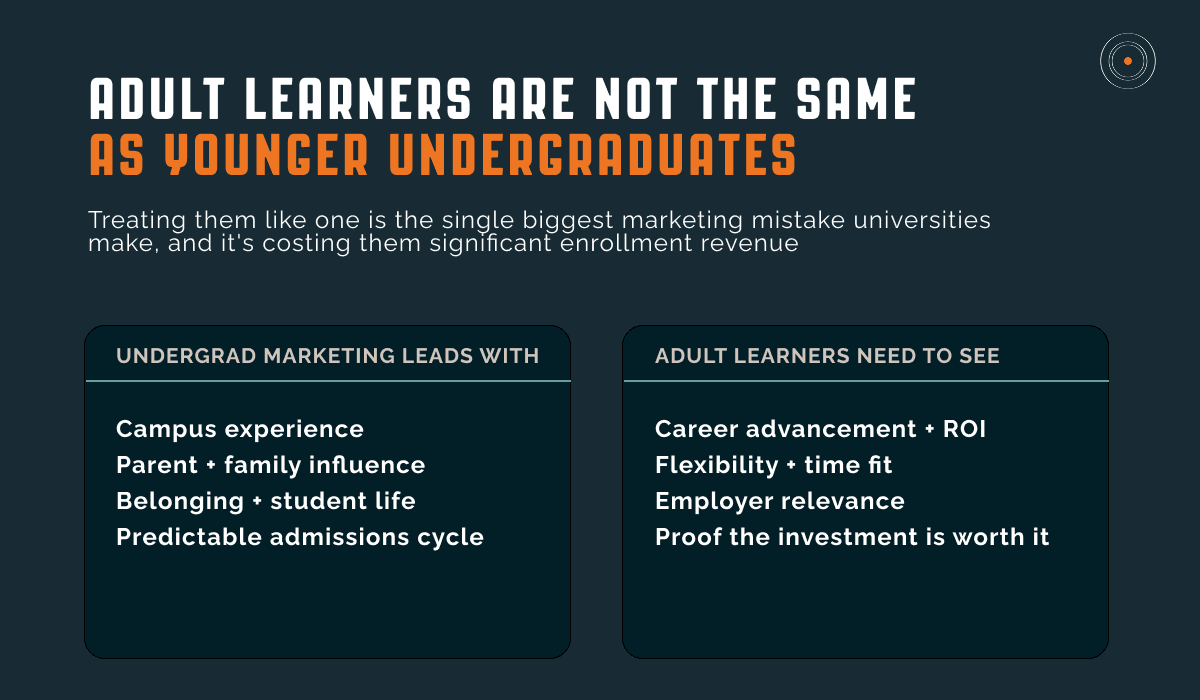
Traditional enrollment marketing fails the graduate/adult learner audience because institutions often treat adults like older undergraduates.
The mistake is not just poorly targeting adults. It’s also treating standard UG marketing metrics as suitable adult or graduate student recruitment strategies.
Traditionally, UG marketing centers around four institutional drivers:
- Campus experience
- Parents/family influence
- Belonging and student life
- Predictable admissions cycle
While great for undergraduates, these drivers have their limits. They don’t work in tandem with adult learner enrollment trends in 2026 or graduate/adult learners’ decision-making factors.
Therefore, universities should center their marketing around six core evaluation criteria:
- Career advancement or transition
- ROI
- Flexibility
- Time constraints
- Employer relevance
- Existing professional identity
As ZGM analyzes graduate and adult learner enrollment trends in 2026, we see one recurring theme: audiences want universities that solve specific problems.
This means institutions should move away from traditional enrollment marketing. Simply changing the age range in your already-existing media plans isn’t enough.
What Do Graduate and Adult Learners Need to See Before They Engage?
Before graduate/adult learners engage with an institution, they need to see relevant proof of concept and minimal risk. That’s why generic creative that focuses on campus experiences, student life, and brand promotion is woefully inadequate.
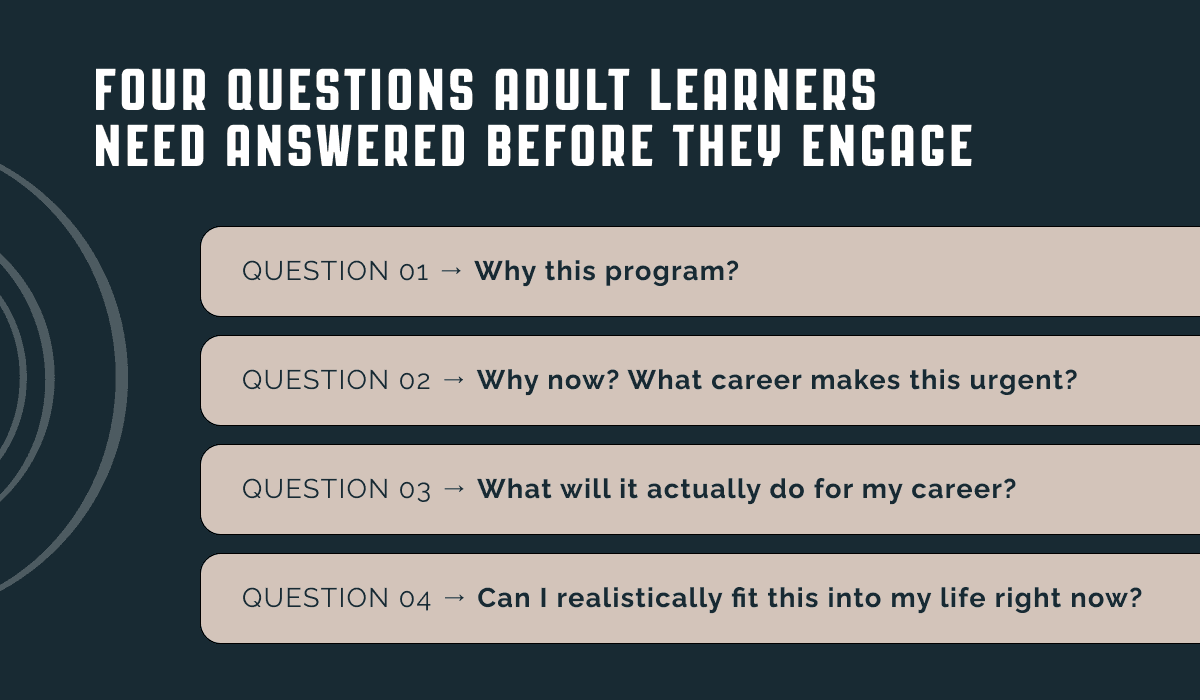
Universities must instead lean into what motivates graduate/adult learners. This means addressing five important questions:
- Why this program?
- Why now?
- What will it do for my career?
- Can I fit it into my life?
- Is the investment worth it?
Answering these questions is bigger than studying graduate or adult learner enrollment trends in 2026.
It requires value-driven content that emphasizes career outcomes, program flexibility, and modality/timeline. Institutions must also highlight their faculty expertise, employer relevance, alumni outcomes, and broader ROI.
Without exception, all pillars have to meet graduate/adult learners where they currently are.
How Should Universities Change the Media Strategy For Non-Traditional Learners?
Universities should change the media strategy for non-traditional learners by shifting from demographic targeting to contextual and behavioral focus. This means not only classifying graduate/adult learners as “working professionals” or “adults aged 25 to 54.”
Rather, institutions should define non-traditional learners by professional context, career interests, and life stages. From there onward, you’ll need a stronger focus on relevant behaviors, content consumption, and intent signals.
Remember, professional adults often vary from prospective undergraduates, especially in their online behavior. Beyond graduate and adult learner enrollment trends in 2026, universities must optimize media that aligns with relevant educational drivers.
Why Does Programmatic Precision Matter More for Graduate and Adult Learners?
Programmatic precision matters more for graduate and adult learners because programmatic can build more precise audiences.
Through StackAdapt targeting, universities should use valuable segmentation criteria to this end. Think about professional context, life stage, behavior, and relevant interests.
When pursuing higher education revenue diversification, institutions must also align themselves with graduate/adult learners’ significant LTV.
Consider this: rather than just labelling non-traditional learners as students aged 25 to 54, highlight professional circumstances and behaviors that correlate with specific program pursuits.
With StackAdapt’s precision, universities can significantly increase enrollments, while avoiding wasted impressions. First, know why graduates and adults might enroll. Then, use media signals to find individuals with these characteristics.
What is Programmatic Advertising?
Programmatic advertising is the use of automated technology and audience/contextual signals to help campaigns move beyond broad demographic targeting.
What Does the Graduate and Adult Learner Journey Look Like Compared to Traditional-Age Undergraduate Enrollment?
Compared to traditional-age undergraduate enrollment, the graduate/adult learner journey looks like completely different architecture.
This is bigger than separate creative for similar audiences. From decision timelines, primary concerns, and influencers to media behavior, content needs, and core questions, traditional and non-traditional learners are worlds apart.
As institutions assess adult learner enrollment trends in 2026 and implement graduate student recruitment strategies, recognizing demographic distinctions is essential.
| Traditional-Age UG | Grad / Adult Learner | |
|---|---|---|
| Decision timeline | Often tied to an annual admissions cycle | Triggered by career, professional, or life circumstances |
| Primary concern | Fit, experience, affordability, belonging | Career value, ROI, flexibility, relevance |
| Influencers | Parents, peers, counselors | Employers, spouse/family, colleagues, professional network |
| Media behavior | Broad social/video/campus-oriented media | Search, professional, contextual, career-oriented environments |
| Content needs | Campus, student life, academics | Outcomes, flexibility, expertise, career relevance |
| Core question | “Where should I go to college?” | “Will this program solve the problem I have right now?” |
How Can Enrollment Leaders Tell Whether the Problem Is Marketing?
Enrollment leaders can tell whether the problem is marketing by implementing a concise, five-question diagnostic:
- Is the program proposition differentiated?
- Does advertising communicate its career relevance?
- Are campaigns reaching people with a plausible reason to enroll?
- Does the landing experience answer their actual questions?
- Are media metrics connected to qualified enrollment outcomes?
Strong programs should yield qualified demand. If the latter is missing, don’t rush to change the program. Instead, try interrogating the brief to ensure alignment with graduate and adult learner enrollment trends in 2026.
Source: AACSB
Amid years of partnering with enrollment leaders, we build data-driven campaigns that actually convert non-traditional learners. Talk to ZGM today about a grad and adult learner enrollment marketing strategy.