

Spring 2027 enrollment outcomes are being decided right now because during Q4, prospective students are researching programs, comparing institutions, and selecting schools for consideration.
Amid Q4’s critical impact on awareness and discovery, there’s one key takeaway for institutions: don’t wait until spring to activate higher education enrollment strategies.
When colleges delay strategic implementation, their goal is generally creating and converting consideration simultaneously. Though in actuality, understanding college enrollment trends in 2027 calls for operating strategically throughout Q4.
During this period, institutions should build enrollment pipelines and maintain visibility. By the time spring rolls around, colleges can enter the season with already-engaged audiences and stronger positioning ahead of yield season.
Introduction
Picture this: the pressure is mounting to increase application and enrollment rates. Campaigns quickly accelerate and teams are expected to deliver rapid results.
Known as the spring scramble, this is all too common and typically traces back to what happened during Q4.
When we assess the college demographic cliff of 2026, projected college enrollment trends in 2027, along with other key data points, we see just how much October, November, and December impact enrollments.
Spring enrollment gets won during Q4 because that’s when institutions can influence the pipeline ahead of conversion pressure peaks. Winning isn’t just about “timing” in isolation. It’s about whether Q4 marketing actively builds a usable enrollment pipeline to facilitate spring 2027 college admissions.
Why Is Spring Enrollment Won in Q4, Not Spring?
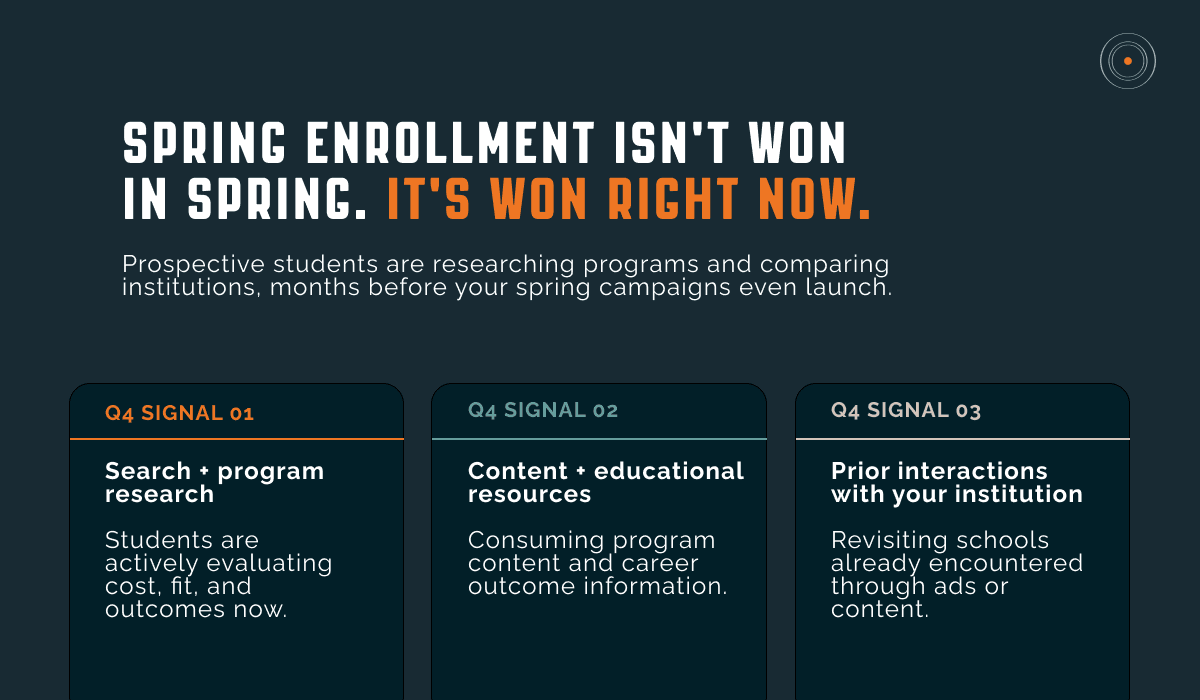
Spring enrollment is won in Q4 because prospective students don’t make decisions right as institutions launch seasonal campaigns. At ZGM, we see this not just across projected college enrollment trends in 2027, but also after years of habitual pattern-tracking.
During Q4, young people generally research programs and compare colleges. They’re also evaluating cost outcomes, flexibility, and overall fit. Truly committed prospective students may even revisit previously encountered schools.
To drive spring 2027 college admissions, institutions need visibility before young people hit the application or conversion stage. That means shifting from spring campaigns (which try converting existing intent) to Q4 pipeline building (which helps create and shape this intent).
By spring, institutions shouldn’t ask “how much can we spend?” On the contrary, they must ask “how much consideration have we already earned?” The latter is where conversion power lies.
What is an Enrollment Pipeline?
An enrollment pipeline is the progression of prospective students from awareness and consideration to inquiry, application, and enrollment.
What Are Prospective Students Doing Right Now and Can They See You?
Right now, prospective students are encountering institutions through four intent signals that allow them to see you. An active research period, Q4 is when students discover colleges via four common pathways:
- Search and research
- Content and educational resources
- Industry/program-related media
- Previous interactions with an institution's website or advertising
During October, November, and December, colleges must put optimal higher education enrollment strategies into practice. Waiting for March or April of 2027 is too late.
When prospective students research program categories during Q4, your institution should be readily visible, available, and aligned with intent. According to UPCEA, prospective students heavily rely upon digital channels to vet institutions and make subsequent decisions.
Why Does Campaign-Only Enrollment Marketing Create a Pipeline Problem?
Campaign-only enrollment marketing creates a pipeline problem because while these campaigns often occur in bursts, student consideration happens continuously.
This structural mismatch doesn’t just make optimizing for college enrollment trends in 2027 much harder. It also leaves frequent gaps between major recruitment pushes.
These gaps then put colleges at a major disadvantage come springtime.
As the season turns, campaign-only enrollment marketing forces institutions to find new audiences and build awareness from scratch. It then becomes necessary to establish consideration, generate applications, and convert prospects…all at once.
Naturally, these demands place more pressure on spring media and enrollment teams. Though contrary to common misconceptions, more advertising isn’t always the solution.
Rather, institutions should strive for a Q4 approach that creates audiences, generates signals, and maintains high-level visibility. This is the foundation that spring campaigns can then build upon in due season.
How Does Programmatic Advertising Keep Institutions in the Consideration Set Year-Round?
Programmatic advertising keeps institutions in the consideration set year-round by maintaining consistent visibility. Given the college demographic cliff in 2026, colleges should strategically optimize programmatic and omnichannel campaigns to streamline student enrollment/retention.
This begins with audience retargeting. With programmatic, institutions have a unique opportunity to stay connected to prospective students with whom they’ve already interacted.
Don’t forget about contextual placement. When colleges opt for programmatic advertising, they can reach prospects who are already consuming content pertaining to their research interests.
Both forms of visibility help institutions align with projected college enrollment trends in 2027. While retargeting supports continuity after identifiable interactions, contextual placements help you connect with students at relevant research moments.
Programmatic advertising shouldn’t just be limited to Q4, though. By integrating programmatic into a broader, year-round system, institutions can avoid bombarding prospective students with ads. This should happen in tandem with ongoing visibility to consideration sets between campaign periods.
At ZGM, we’ve seen this play out across many colleges. Q4 programmatic activity, when done right, helps spring campaigns reach high-intent audiences with prior engagement and greater predisposition to enrollment.
Which Q4 Behaviors Do High-Performing Enrollment Teams Have in Common?
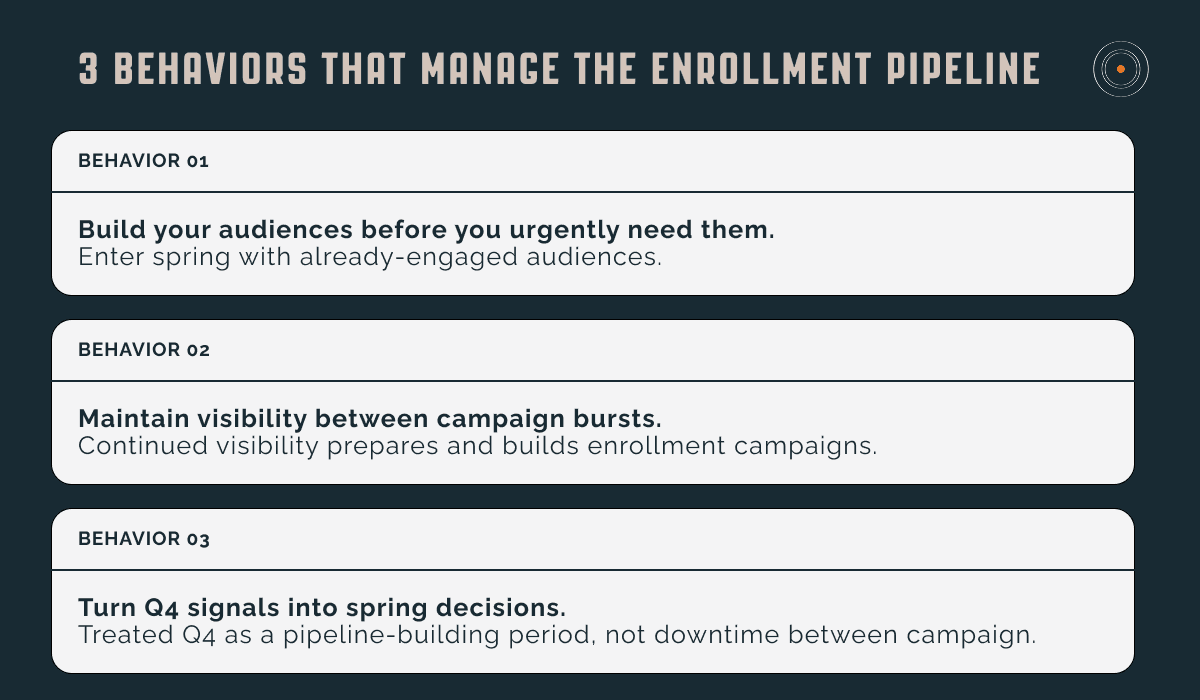
High-performing enrollment teams have the following Q4 behaviors in common: managing the pipeline, building audiences before they’re urgently needed, maintaining visibility between campaign bursts, turning Q4 signals into spring decisions, and defining success beyond immediate conversions.
These higher education enrollment strategies go hand-in-hand with not just boosting spring 2027 college admissions, but also aligning campaigns with college enrollment trends in 2027.
- They manage the pipeline, not just the campaign calendar.
- By managing the pipeline and not just the campaign calendar, Q4 gets treated like a pipeline-building period, instead of just downtime between campaigns.
- They build audiences before they urgently need them.
- By building audiences ahead of schedule, institutions can manage the college demographic cliff in 2026 while identifying, developing, and refining priority audiences before spring 2027.
- They maintain visibility between campaign bursts.
- By implementing retargeting and contextual strategies, colleges reap the benefits of staying present as prospective students conduct research.
- They turn Q4 signals into spring decisions.
- By turning Q4 signals into spring decisions, institutions can ensure their messaging, targeting, and investments during spring are well-informed by audience behavior and media performance.
- They define success beyond immediate conversions.
- By defining success beyond immediate conversions, colleges operate in spring with the strong consideration and audience intelligence built during Q4.
What Does a Q4-to-Spring Enrollment Strategy Look Like?
A Q4-to-spring enrollment strategy looks like maintaining a connected system throughout the student’s decision journey. To accomplish this while accounting for college enrollment trends in 2027, institutions should avoid running the same campaign all year.
| Campaign-Sprint Approach | Year-Round Pipeline Approach |
|---|---|
| Activates when enrollment pressure rises | Builds momentum before pressure peaks |
| Creates audiences when campaigns launch | Develops audiences continuously |
| Focuses heavily on immediate conversion | Builds awareness, consideration, and conversion |
| Goes quiet between major campaigns | Maintains strategic visibility |
| Starts spring with limited audience intelligence | Enters spring with accumulated behavioral signals |
Why Should Enrollment Leaders Be Thinking About Spring Yield Right Now?
Enrollment leaders should be thinking about spring yield right now because spring’s outcomes are largely determined by the pipeline built during Q4. When assessing projected college enrollment trends in 2027, the data clearly shows a bifurcated landscape dominated by intense competition and shrinking student pools.
To drive spring 2027 college admissions, make sure you can answer the following five questions ahead of Q1:
- Which priority programs need more pipeline?
- Which audiences are currently researching?
- Where are those audiences spending time?
- What happens after a prospective student first engages?
- What Q4 signals will actually influence spring strategy?
Source: AGB
At ZGM, we treat enrollment as a year-round system. Our partnerships with higher ed marketers ultimately connect audience development, media, and enrollment outcomes, rather than treating each campaign as a separate silo.
Speak with ZGM today about building a year-round enrollment marketing strategy.