



The agencies winning right now are built around data, not creative, because data is what makes creative accountable.
Heading into 2027, putting data first requires building infrastructure, measurement, and decision-making around real signals, not assumptions.
For any forward-thinking, data-driven marketing agency, this begins with adapting to the privacy-first era. It also requires embracing automation, media mix modelling (MMM), and incremental testing.
Amid analyzing performance marketing trends, one key point is made abundantly clear: clients are increasingly needing agencies to demonstrate tangible business impact. Just producing impressive work isn’t enough.
Truly proving ROI in the current landscape requires agencies to make new investments and ensure that creative remains accountable. To this end, we’ll have a close look at the biggest challenges of a data-driven marketing agency and what clients are actually looking for.
Why Are Creative-Led Agencies Struggling to Prove ROI in 2026?
Creative-led agencies are struggling to prove ROI in 2026 because of evolving client expectations and lack of pipeline/revenue impact from creative. CMOs and marketing leaders now face more pressure to justify spend. Simply claiming that creative “performed well” without supportive evidence isn’t enough anymore.
Upon reviewing current marketing data analytics, there’s one important takeaway: great creative can garner attention even without proving effectiveness. This is problematic not because of creative itself…but because measurements are improperly treated as post-creative occurrences.
Going into 2027, the most efficient data-driven marketing agency won’t be one that abandons creative altogether. On the contrary, agencies gain tangible advantages by building the creative process on top of better data.
What Does “Data-First” Actually Mean for an Agency?
For an agency, “data-first” means building infrastructure, measurement frameworks, and decision-making processes around signals instead of assumptions.
This goes beyond a data-driven marketing agency simply having a dashboard. It requires integrating data across operational layers, leaning into validation over “gut feelings” and automating real-time workflows.
Don’t forget, a dashboard alone isn’t a data strategy. It’s just providing surface-level information.
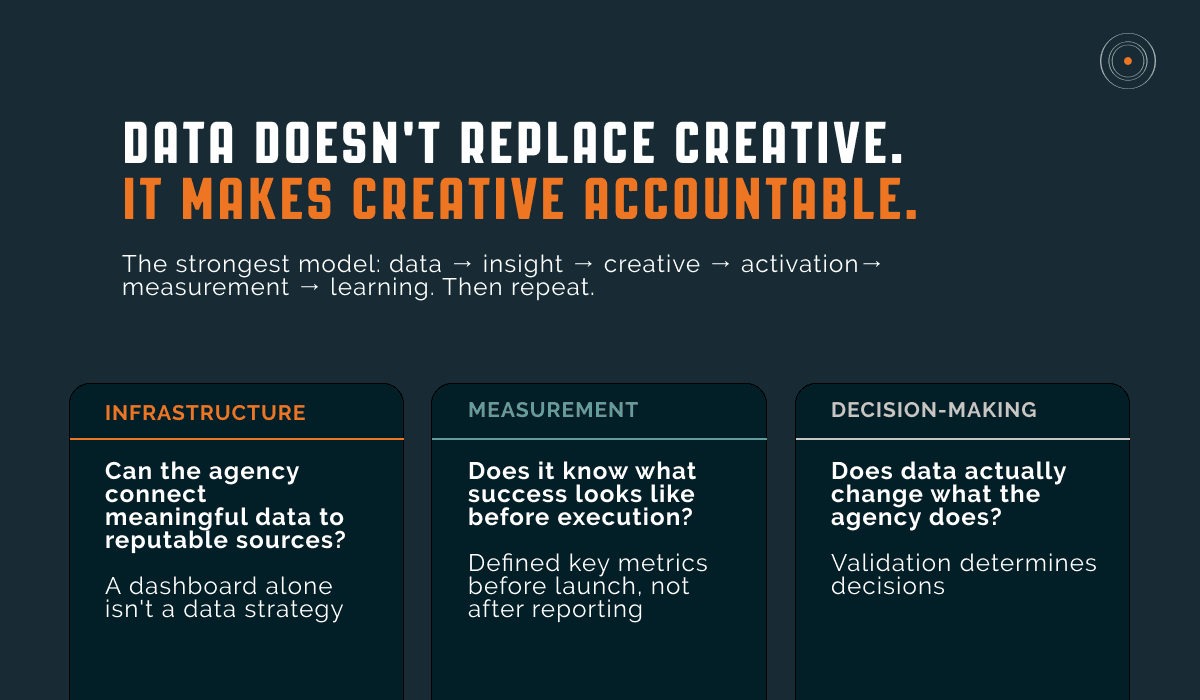
Here’s how a real data strategy breaks down across infrastructure, measurements, and decision-making:
- Infrastructure: Can the agency connect meaningful data sources?
- Measurement: Does it know what success looks like before execution?
- Decision-making: Does data actually change what the agency does?
Why Is Data First—But Not Data Instead of Creative?
It’s data first (and not data instead of creative) because data affords intelligence and accountability, while creative provides differentiation, emotional connection, and memorability.
Going into 2027, any data-driven marketing agency should recognize the strongest model as follows: data → insight → creative → activation → measurement → learning.
In fact, when agencies have a framework for testing whether an idea worked, data can actually enable more creative risk.
A clear review of creative strategy, AI, and performance marketing trends drives home another key point about data: it shouldn’t tell creatives what to make. Instead, data should inform the agency of who it’s working to reach, what must transpire, and whether the work is achieving core objectives.
At ZGM, we have firsthand experience with taking a data-first approach to our service lines. From programmatic for signal to RevOps for pipeline visibility and content for measurable demand, ZGM uses data to build the sandbox, which gives creative the freedom to play.
How Do Data-First Agencies Put This Philosophy Into Practice?
Data-first agencies put this philosophy into action by optimizing tools like programmatic, RevOps, and high-level content. By streamlining data across multiple branches, a data-driven marketing agency can ultimately eliminate silos while maximizing ROI.
How Does Programmatic Turn Data Into Audience Intelligence?
Programmatic turns data into audience intelligence by augmenting data signals. We see this across multiple levers from audience behavior and response to channel-level performance, impression frequency, and conversion paths.
The rollout of ChatGPT Ads inventory via StackAdapt is a prime example of this. Here, programmatic gets a clear runway to help agencies shift their strategy from reactive buying to proactive audience intelligence.
Turning data into audience intelligence isn’t just about being first to a new channel. It’s about ensuring the channel can test, measure, interpret, and learn from the new signals it’s producing.
As the most data-rich channel within a marketer’s mix, programmatic functions as a foundational growth engine that translates raw, cross-channel signals into actionable business growth.
How Does RevOps Connect Marketing to Revenue?
RevOps connects marketing to revenue by extending measurements beyond simple campaign metrics. When assessing marketing data analytics, it’s clear that marketing is more defensible when its impact can be followed beyond the click.
By connecting marketing activity to bottom-line results (like lead quality, pipeline, sales progression, and revenue), RevOps can cleanly justify a data-driven marketing agency’s spend.
How Can Content Become Part of a Measurable Demand Engine?
Content can become part of a measurable demand engine by driving engagement, conversion, and customer interest. Agencies should lean into this even when attribution is difficult to prove.
In 2026, performance marketing trends consistently show that content is more than just output volume. Rather, it functions as a key lever that does the heavy lifting of audience targeting.
That matters for proving any agency’s data capabilities.
What Should Clients Look for When Evaluating an Agency's Data Capabilities?
When evaluating an agency’s data capabilities, clients should look for the process behind the reporting. This means directly seeking evidence for the following, five pillars:
- Connected data infrastructure
- Clear measurement methodology
- Testing and optimization
- Cross-channel intelligence
- Connection to business outcomes
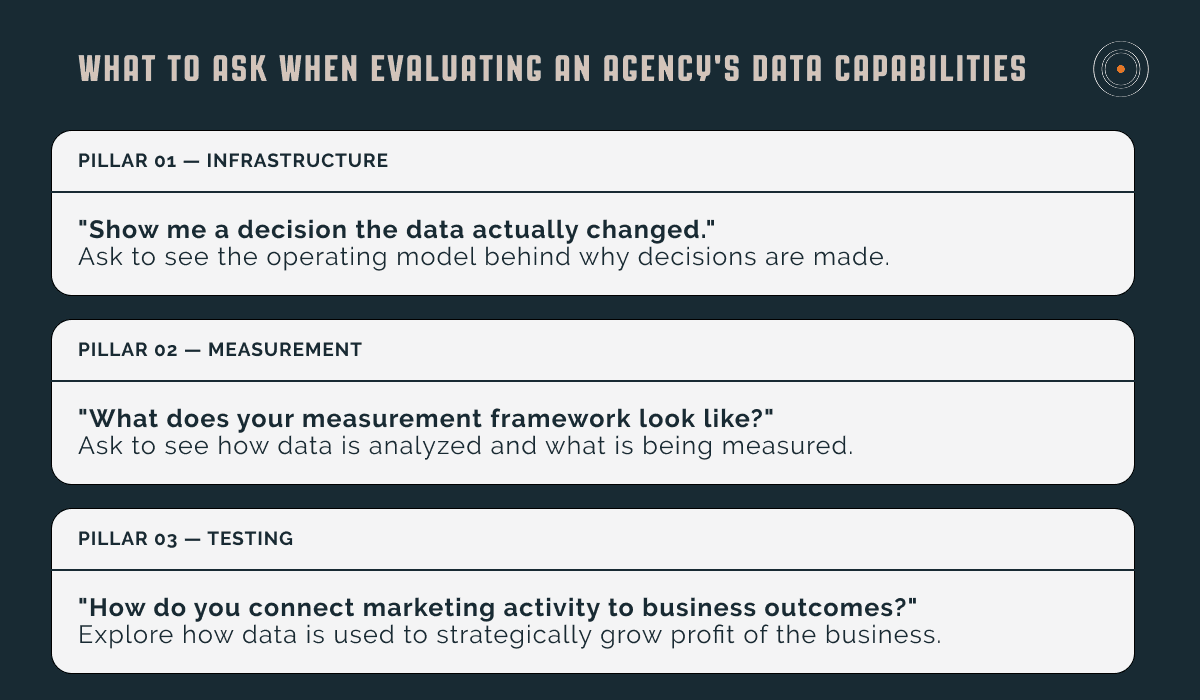
Remember, the pitch deck isn’t the proof. The operating model is and what a data-driven marketing agency says sometimes differs from what clients should actually ask.
According to Gartner, failure to demonstrate sufficient returns causes influential loss for more than 40% of CMOs seeking larger brand budgets.
| What an agency says | What clients should actually ask |
|---|---|
| “We have real-time dashboards.” | “Show me a decision the data changed.” |
| “We're data-driven.” | “What does your measurement framework look like?” |
| “We use advanced analytics.” | “Which business decisions does it improve?” |
| “We optimize constantly.” | “What signals trigger an optimization?” |
| “We understand attribution.” | “How do you connect marketing activity to business outcomes?” |
What Will Separate the Best Agencies in 2026?
Making data the foundation for synergized creative, media, content, and revenue operations is what will separate the best agencies in 2026.
A winning data-driven marketing agency isn’t choosing data over creative. It’s using data to establish accountability as creative gets attention. Then, intelligence further optimizes the next decision.
Heading into 2027, clients aren’t asking whether agencies are creative-driven or data-driven. They’re wanting to know whether agencies have the data infrastructure to ascertain creative’s efficiency.
Source: Zappi
Through our proven frameworks, ZGM consistently helps brands capture market share and drive predictable revenue growth. Book a call with us now to start building data-engineered strategies and deliver what markets are actually looking for.