



The 2027 enrollment marketing plan most universities haven’t written yet is one that connects enrollment goals to audiences, funnel stages, channel roles, budget, sequencing, and measurable outcomes.
Moving forward, higher ed enrollment marketing strategies shouldn’t just primarily reallocate last year’s budget. Rather, they should support effective Spring 2027 execution, while aligning with higher education marketing trends in 2026.
This allows universities to operate with a strategic roadmap while simultaneously optimizing essential tools like programmatic, click-focused reporting, and AI personalization in higher education.
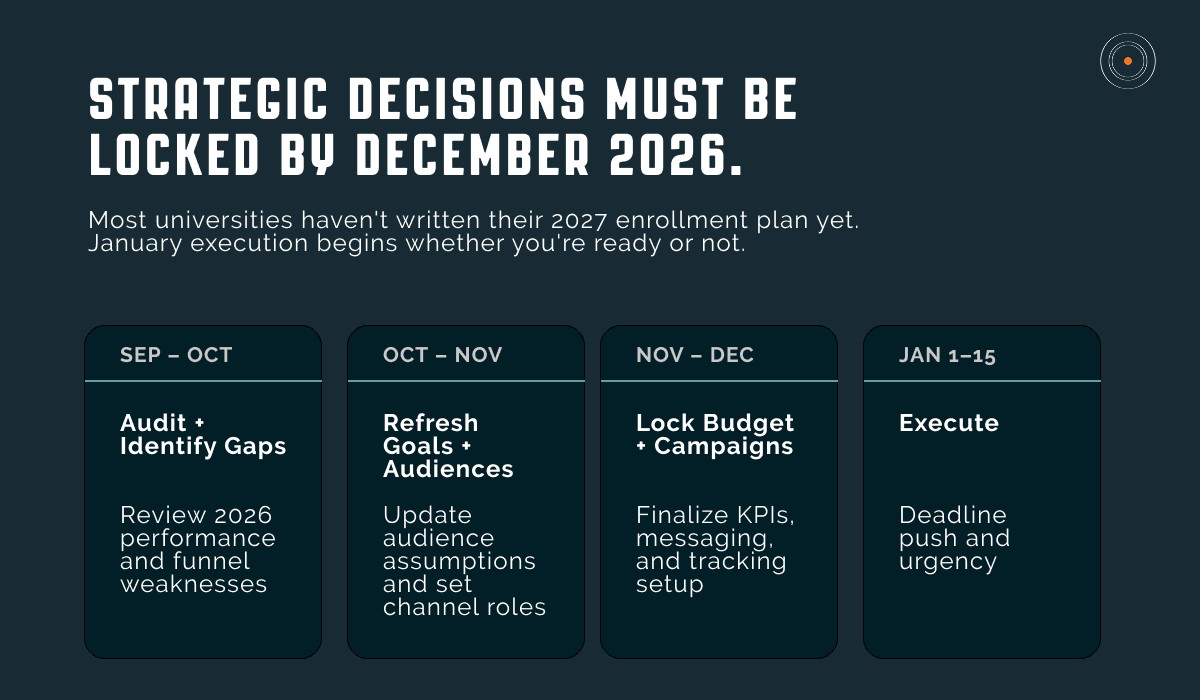
The clock is ticking. Universities should make all strategic decisions about their 2027 enrollment marketing plan by December 2026.
Moving forward, we’ll carefully dissect the best month-by-month planning timeline, five disastrous mistakes to avoid, and how to effectively implement higher ed enrollment marketing strategies.
What separates a real enrollment marketing plan from a budget reallocation?
A central focus on enrollment goals is what separates a real enrollment marketing plan from budget reallocation.
Universities (instead of building their plan forward from existing channels) should prioritize the following key points:
- Enrollment objectives
- Audience priorities
- Funnel gaps
- Channel roles
- Budget
- Measurement
While budget exercises ask “where should we put last year’s dollars,” a strategic roadmap that centers higher ed enrollment marketing strategies asks “what enrollment outcomes do we need, which audiences will get us there, and how should channels work together?”
Going into 2027, universities should recognize an enrollment marketing plan as a coordinated roadmap that connects enrollment goals, audiences, channels, messaging, timing, budget, and measurement across the prospective student journey.
When should universities lock their 2027 enrollment marketing decisions?
Universities should lock their 2027 enrollment marketing decisions by December 2026. This window is when initial applicant data arrives, major early application cycles wrap, and recruitment campaigns pivot towards standard decision deadlines and spring yield efforts.
Ahead of January’s execution period, universities should utilize search everywhere optimization (SEO). During the December pivot, this strategy helps capture prospects’ last-minute regular decision interest while also energizing spring yield campaigns and AI search discovery.
For the best outcomes with search everywhere optimization and broader higher ed enrollment marketing strategies, universities must adhere to the following timeline:
- September–October: Audit 2026 performance and identify funnel gaps
- October–November: Refresh audience assumptions, establish goals, and determine channel roles
- November–December: Finalize budget, sequencing, messaging, KPIs, campaign production, implementation and tracking
- January 1- January 15: Deadline execution and urgent push
- Spring 2027: Yield marketing and optimization
How should the 2027 channel mix work across the enrollment funnel?
Across the enrollment funnel, the 2027 channel mix should work via defined operational objectives, alongside sequencing around prospect behavior and funnel stages. Budget allocation alone isn’t enough.
Programmatic also plays a significant role in the 2027 channel mix. Aligned with both higher ed enrollment marketing strategies and higher education marketing trends in 2026, programmatic comes with clear advantages.
Rich in signal, this system is useful for reaching qualified audiences earlier in the journey. Programmatic (despite being widely underutilized or treated as an afterthought) can likewise reinforce search, email, and other touchpoints.
Remember, the strongest enrollment marketing plans don’t run channels in isolation. Instead, these plans integrate and sequence channels according to a prospect’s position in the funnel. Put simply, programmatic optimizes the channel mix while still removing bottlenecks.
As 2026 concludes, universities should recognize programmatic advertising as an automated media buying system. This system uses audience and contextual signals to determine where and when advertising reaches prospective students.
| Channel | Primary funnel role |
|---|---|
| Programmatic | Awareness + consideration |
| Paid search | High-intent discovery + conversion |
| Nurture + application/yield | |
| Organic | Discovery + consideration |
| Cross-channel sequencing | Moves prospects between stages |
What should enrollment leaders measure and report to leadership?
Enrollment leaders should measure and report the following metrics to leadership: enrollment, yield, applications/admissions/inquiries, qualified engagement, and clicks/impressions.
These data points collectively encompass the full enrollment marketing funnel amid prioritizing enrolled students as the ultimate goal. While clicks and CTR are useful diagnostics, universities must not mistake them for headline KPIs, as suggested by Full Fabric’s higher education insights.
Instead, leadership reporting should clearly answer the following four questions:
- What enrollment outcome are we targeting?
- What funnel gap are we addressing?
- What investment is required?
- What outcome will demonstrate success?
As enrollment leaders report to institutional leadership, it’s essential to recognize yield as the percentage of admitted students who convert to enrolled students.
What are the five planning mistakes that undermine 2027 enrollment performance?
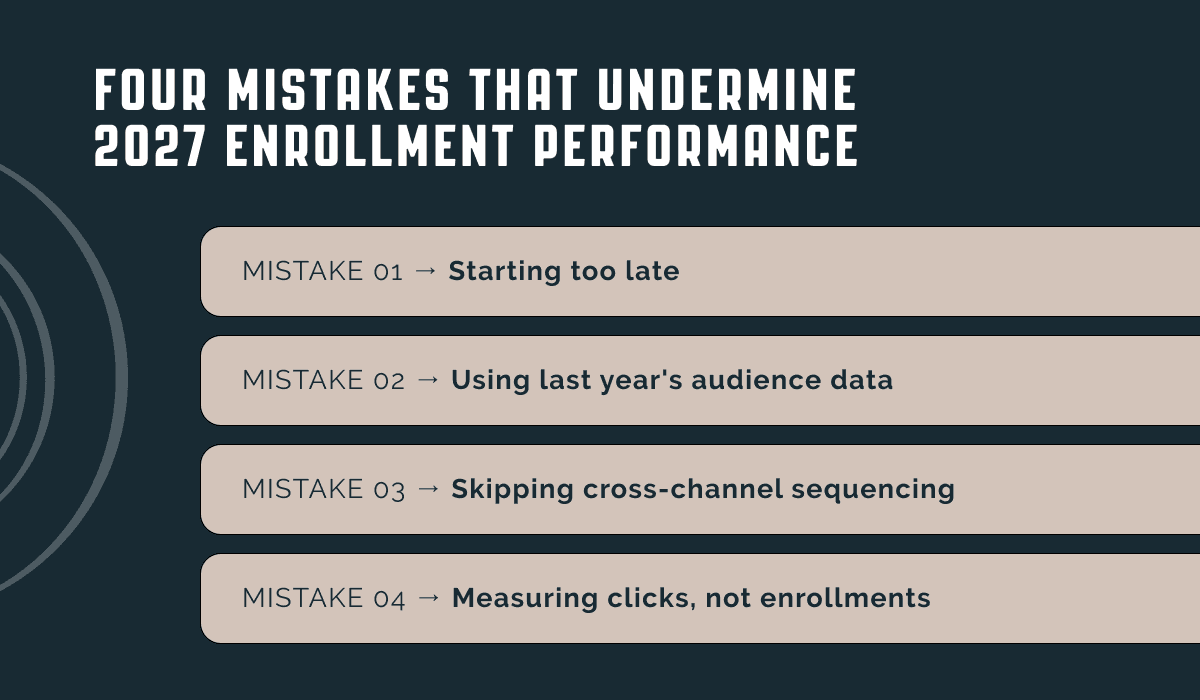
Starting too late, using last year’s audience data, skipping cross-channel sequencing, ignoring yield, and measuring clicks instead of enrolled students are the five planning mistakes that undermine 2027 enrollment performance.
By means of higher ed enrollment marketing strategies that include full-funnel CRM integration, first-party predictive modeling, programmatic, and search everywhere optimization, universities can avoid the following pitfalls:
- Starting too late: This leaves no time for strategy, production, or testing.
- Using last year's audience data: This assumes yesterday's audience behavior will automatically predict 2027.
- Skipping cross-channel sequencing: This allows paid, organic, email, and programmatic efforts to operate independently.
- Ignoring yield: This optimizes acquisition without accounting for what happens after inquiry, application or admission.
- Measuring clicks instead of enrolled students: This confuses activity with enrollment impact.
What belongs in a 2027 enrollment plan that is usually missing?
Strategic focus, execution, financials, retention, and analytics belong in a 2027 enrollment plan, but are usually missing.
When universities miss these critical elements, they’re dealing with more of a budget document than an enrollment strategy.
| A real 2027 plan includes | What's often missing |
|---|---|
| Enrollment targets | Program-level/funnel targets |
| Updated audience strategy | Fresh audience assumptions |
| Defined funnel roles | Cross-channel sequencing |
| Strategic programmatic use | Programmatic as an afterthought |
| Budget scenarios | Outcome-based investment logic |
| Yield strategy | Post-application/admit planning |
| Enrollment KPIs | Click-focused reporting |
| Optimization plan | Decisions made only after launch |
How should universities build an enrollment marketing plan before Spring 2027?
Before Spring 2027, universities should build their enrollment marketing plan with a carefully optimized funnel roadmap.
An essential framework that aligns with higher ed enrollment marketing strategies, here’s a step-by-step breakdown of that funnel roadmap:
- ☐ Define enrollment targets.
- ☐ Identify funnel gaps.
- ☐ Refresh audiences.
- ☐ Assign channel roles.
- ☐ Map cross-channel sequencing.
- ☐ Model budget scenarios.
- ☐ Establish enrollment/yield KPIs.
- ☐ Lock strategic decisions by December
Conclusion
As we assess higher education marketing trends in 2026, the path ahead for 2027 is clear: an enrollment plan shouldn't only answer: “How much will we spend?”
On the contrary, a 2027 enrollment plan should answer the following queries:
- “Which students are we trying to reach?”
- “What needs to happen at each funnel stage?”
- “How will our channels work together?”
- “How will we know that investment produced enrollment?”
With an optimized channel mix, timely marketing decisions, and a strategic roadmap ahead of January 2027, universities can drive proactive engagement before spring recruiting begins.
Source: EAB
At ZGM, we’ve proudly helped enrollment teams draw up real plans and avoid common pitfalls that undercut the funnel. Book a call with us now to prepare your 2027 enrollment marketing plan by December 2026.