


The attribution problem that’s killing higher ed marketing budgets is a lack of consistently captured interactions across the digital, organic, and offline spheres. Enrollment journeys span 12 to 18 months. Failure to consistently capture these interactions leads to the breakdown of traditional marketing attribution in higher education.
Institutions don’t have to search for a “perfect” model to remedy this problem. Conversely, they should build a precise measurement framework that fuses observable outcomes, behavioral signals, CRM data, and direct acknowledgement of uncertainty.
According to AI Digital, a higher ed enrollment marketing approach that leverages first-party data and predictive analytics helps institutions score prospects while optimizing campaigns across the full student lifecycle.
Looking ahead, we’ll carefully assess higher education marketing trends in 2026. We’ll also review the problems with multi-touch attribution and what universities should actually be measuring.
Why Is Higher Ed Attribution So Difficult to Prove?
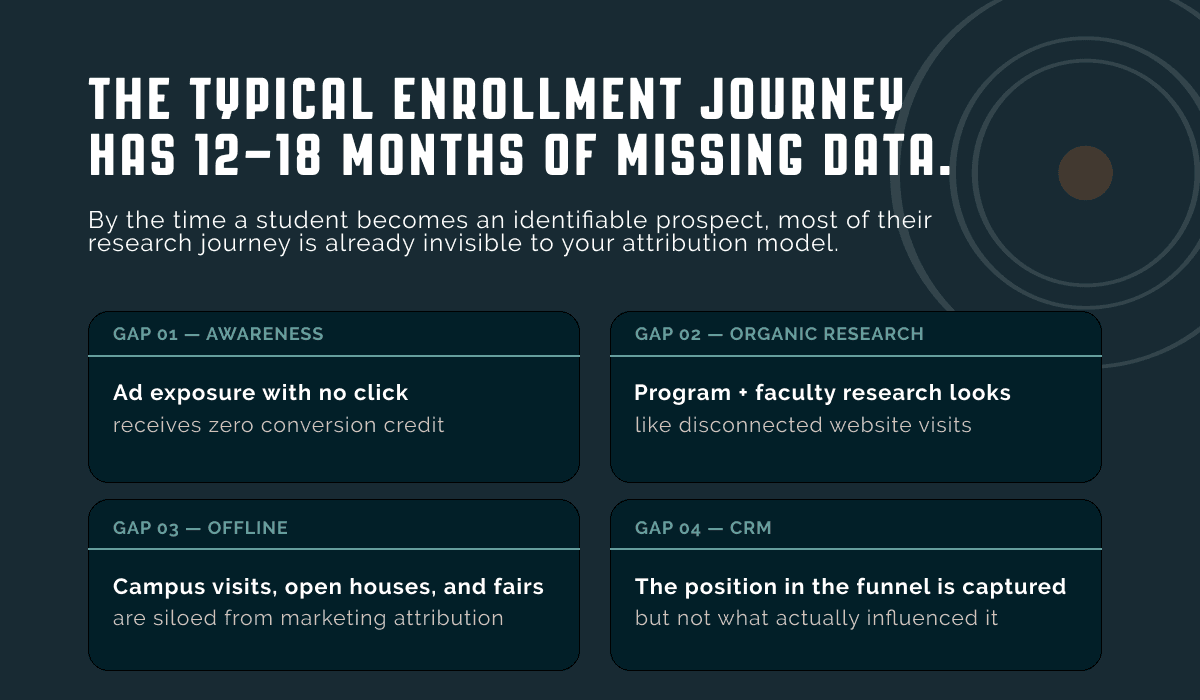
Higher ed attribution is so difficult to prove because over a 12 to 18 month journey, prospective students research across channels, devices, and online/offline environments. By the time these students become identifiable prospects, much of the journey has already finished.
Colloquially known as the “dark funnel,” this challenge with marketing attribution in higher education leads to problematic downstream effects. For instance, enrollment managers may know marketing is working, yet struggle to prove it in board meetings.
Meanwhile, leadership wants to see which channels are actually driving applications and enrollments. On key metrics like cost per enrolled student and cost per application, the data often produces deceptively simple answers to complex questions.
Here’s the bottom line: marketing attribution in higher education measures observable data connectivity, not each human influence point.
What Is Multi-Touch Attribution and Why Doesn't It Work for Enrollment?
Multi-touch attribution is assigning conversion credit across multiple marketing interactions, rather than assigning all credit to one touchpoint.
This doesn’t work for enrollment because in higher ed, credit can only be distributed across observable, connected interactions. This inherently leaves major parts of the enrollment journey completely invisible.
In assessing marketing attribution in higher education, we see the problems with multi-touch across all models:
- Last-click: gives the final measurable interaction too much credit
- First-click: gives the initial interaction too much credit
- Linear: assumes equal contribution across every measurable touchpoint
- Time-decay: favors recent interactions, can undervalue early awareness
- Data-driven: constrained by incomplete data despite being more sophisticated
Across the board, better math doesn't solve missing data.
| Model | What it gets right | Where it breaks in higher ed |
|---|---|---|
| Last-click | Easy to understand | Ignores the research journey |
| First-click | Captures initial discovery | Ignores later influence |
| Linear | Recognizes multiple touches | Treats unequal interactions equally |
| Time-decay | Reflects recency | Undervalues early awareness |
| Data-driven | Uses observed patterns | Can't model what isn't captured |
Which Parts of the Enrollment Journey Are Attribution Missing?
Awareness, organic research, offline occurrences, and CRM are parts of the enrollment journey missed by attribution. Overlooking these components doesn’t merely undermine marketing attribution in higher education. It also leads to misallocated budgets and distorted ROI perception.
What happens to awareness?
Awareness happens when a prospective student sees programmatic/social/video advertising months before becoming identifiable to higher ed marketers. Since this prospect doesn’t click on the advertising, the exposure receives little to no conversion credit. Later, the student organically searches, then applies.
What happens to organic research?
Organic research happens when students repeatedly research programs, tuition, faculty, outcomes, rankings, and campus life. Be aware that gaps in higher ed enrollment marketing can leave these interactions looking like disconnected website visits, rather than a long research journey.
What happens offline?
Offline interactions happen across campus visits, open houses, advisor calls, college fairs, and informational sessions. Despite their influential nature, these interactions often live in systems that are siloed from marketing attribution in higher education.
What happens to the CRM?
The CRM happens when institutions learn a prospect’s current position in the funnel and what transpired from it. However, this doesn’t always encompass a complete record of what actually influenced the prospect. Going into 2027, Slate has become the backbone of first-party enrollment data for many universities.
Don’t Miss ZGM’s AMA Conference in November 2026
This fall, ZGM is hosting a workshop to help higher education institutions build optimal enrollment platforms. By fusing technology, data, and governance, universities will find themselves best equipped to expand their digital ecosystems through methods that support marketing attribution in higher education.
What Should Higher Ed Marketers Measure Instead of Multi-Touch Attribution?
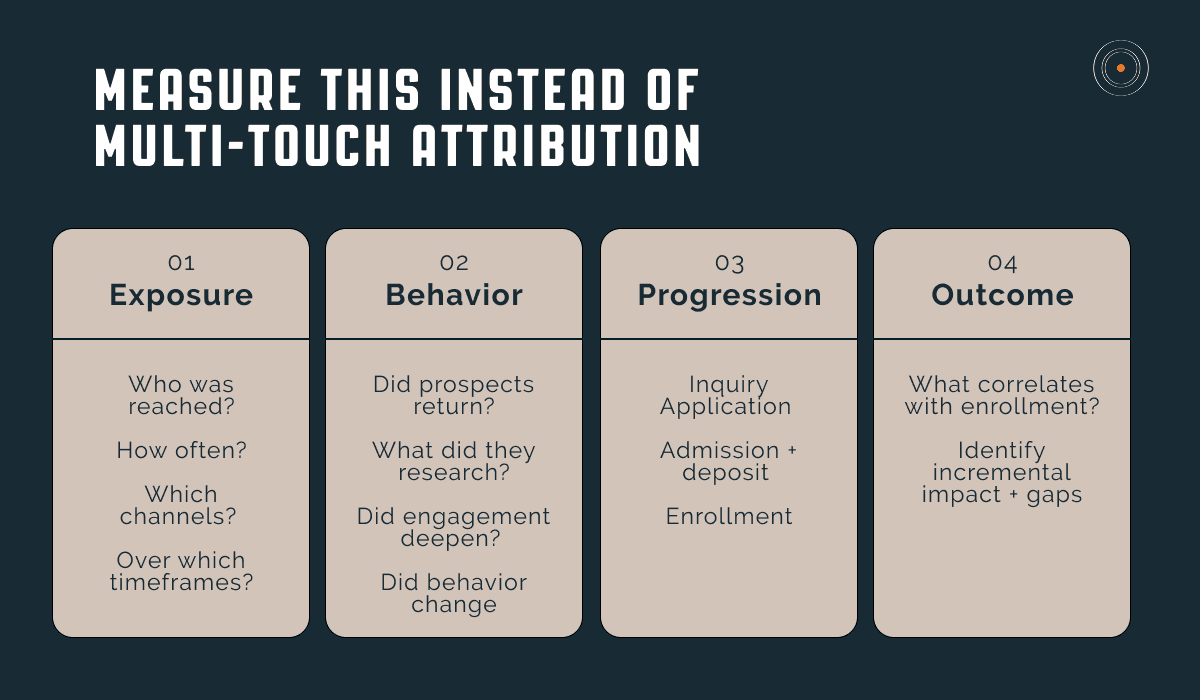
Instead of multi-touch attribution, higher ed marketers should measure exposure, behavior, progression, and outcome. This approach aligns with higher education marketing trends in 2026 while simultaneously helping enrollers manage uncertainty.
Leadership doesn’t necessarily need a perfect attribution percentage. They should, however, understand what the institution knows, its confidence levels, and what action is supported by existing evidence.
As a general rule of thumb for higher ed enrollment marketing, observations should be directly measured. Likewise, inferences require support from multiple signals, just as estimates ought to be based on modeling.
1. Exposure
Exposure measurements should center around which prospects were reached and how often they were reached. Marketers also need to track which channels connected with prospects, along with the adjoining time periods.
2. Behavior
Behavior measurements should focus on whether prospects returned and which programs/content they researched. Likewise, marketing attribution in higher education requires tracking whether engagement deepened and if prospect behavior changed after exposure.
3. Progression
Measuring progression means tracking inquiry, application, admission, deposit, and enrollment. During this stage, higher ed marketers can greatly benefit from the valuable first-party context of Slate and CRM data.
4. Outcome
Outcome measurements need to center around the audiences, programs, and channels that correlate with enrollment. Higher ed marketers should also understand existing incremental impact and what ultimately remains unknown.
How Can Programmatic Help Fill the Attribution Gaps?
Programmatic can help fill the attribution gaps by generating impression-level data and behavioral signals. Optimizing programmatic for marketing attribution in higher education helps universities detect exposure even when a prospective student never clicks.
Remember, impression-level data and behavioral signals should be considered alongside site behavior, CRM progression, application activity, and enrollment outcomes.
Programmatic exposure → behavioral engagement → identifiable prospect → CRM progression → enrollment
Programmatic data doesn’t magically prove causation, but it does fill some visibility gaps left behind by click-based attribution. To this end, higher ed marketers should treat programmatic as behavioral evidence that reconstructs the journey, not the answer to attribution itself.
How Should Leadership Think About Attribution Uncertainty?
Leadership should think about attribution uncertainty by treating better-informed budget decisions as the goal.
Instead of assigning 37% of enrollment to Channel X, leadership should know what requires direct attribution and how behavioral evidence suggests influence. Institutions must also be clear on what they can’t currently measure and how to test the remaining uncertainty.
Source: Braze
At ZGM, we proudly partner with higher ed enrollment directors, helping them secure clean data that supports their budgets. Book a call with us now to fix attribution problems and optimize your conversion funnel.