


Prospective students research colleges the way they shop for products because AI chat, social media sites (like TikTok and Reddit), and other peer networks are their trusted sources of information.
Here’s what that means for higher education enrollment marketing: Gen Z and Gen Alpha don’t want to feel like they’re being marketed to. These prospective students also don’t neatly move from awareness to application.
Given the rapid changes in the college search process, enrollment marketers must show up where research actually happens…not just where applications take place. Moving forward, we’ll have a closer look at how this all works, what the shifting student recruitment marketing trends indicate, and why bridging the trust gap is so critical going into 2027.
Why Does College Research Now Look More Like Consumer Research?
College research now looks more like consumer research because Gen Z’s journey is fragmented. Instead of following a linear website path that aligns with the traditional enrollment funnel, prospective students want peer proof and fast, mobile-first communication.
This is why we see Gen Z and Gen Alpha discovering schools on TikTok, watching campus tours on YouTube, and searching Reddit for student opinions.
Here’s another takeaway from student recruitment marketing trends: viable prospects often direct message (DM) university attendees to get feedback. It’s also common for prospects to use ChatGPT when comparing various institutions.
As universities update their digital marketing strategy for higher education, they shouldn’t limit college research to just a “Gen Z social media” story. Instead, they should recognize the evolving college search process as a transition from brand-controlled journeys to consumer-controlled research.
Put simply, aligning with current student recruitment marketing trends requires marketers to rethink where influence actually happens.
What Do Prospective Students Trust When They're Researching Colleges?
When prospective students are researching colleges, they trust current students, alumni, peers, UGC, and online communities.
Conversely, university messaging now faces a significant trust gap. Gen Z continues leaning away from institution-controlled communication, per User Intuition. Instead of trusting a website about what campus life entails, prospective students prefer peer-created content that shows how campus life feels.
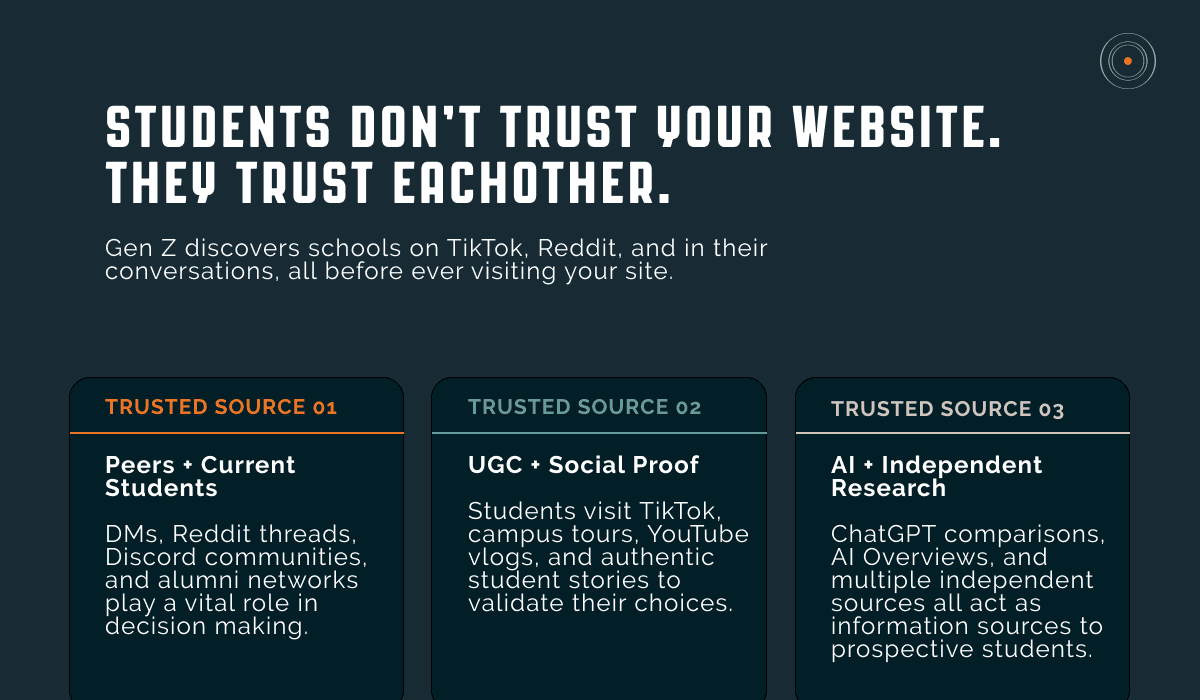
We see similar parallels when it comes to consumer marketing. In this arena, recommendations, reviews, creators, and social proof drive major purchase decisions. The stakes are even higher for Gen Z choosing a college. This makes it critical for universities to adapt to the best student recruitment marketing trends.
Moving into 2027, enrollment marketers must recognize social proof as using other people’s experiences or opinions as decision-making evidence. For Gen Z researching colleges, social proof revolves around student stories, UGC, peer recommendations, reviews, and authentic community conversations.
How Should Enrollment Marketers Think About the New Research Journey?
Enrollment marketers should think about the new research journey by introducing zero-click search moments.
With zero-click search, universities aren’t just aligning themselves with student recruitment marketing trends. They’re also being useful and visible even when prospective students never visit the university’s website.
Ultimately, this approach to higher education enrollment marketing builds the bridge to channel strategy.
As enrollment marketers navigate the new research journey, they should recognize zero-click search moments as timeframes in which necessary information arrives directly via search or discovery experience without visiting a website.
The traditional funnel, while not completely obsolete, still fails to capture everything occurring before and between official touchpoints.
| Traditional Enrollment Funnel | Modern Research Journey | |
|---|---|---|
| Discovery | Search, ads, university website | TikTok, YouTube, social, AI, peers |
| Research | Admissions content | Reddit, UGC, DMs, Discord, video |
| Trust | Institutional authority | Peer experiences + social proof |
| Comparison | University materials | Multiple independent sources |
| Journey | Linear | Nonlinear and cross-channel |
What Should Change About Enrollment Marketing?
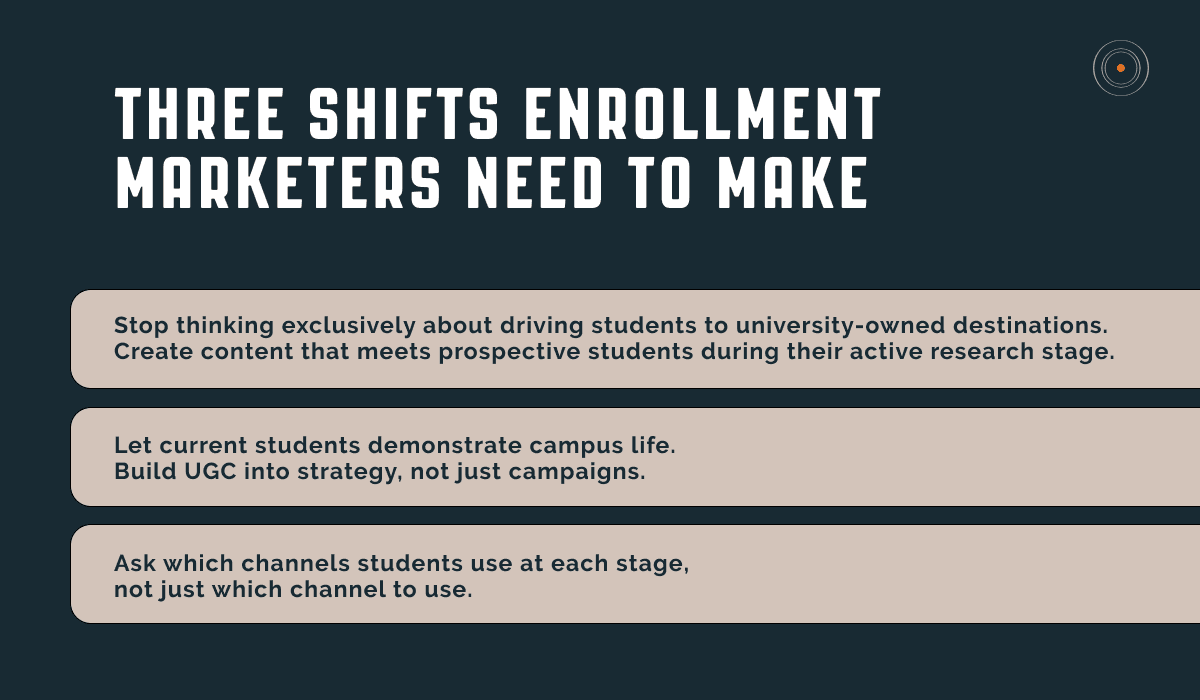
When navigating enrollment marketing, universities should change from outbound to discovery, from institutional claims to social proof, and from channel silos to journey-based targeting.
With this enhanced approach, universities can use student recruitment marketing trends to their advantage, maximizing funnel effectiveness in an increasingly competitive, complex landscape.
1. From outbound to discovery
Changing from outbound to discovery means creating content that meets prospective students during the active research stage. This approach to the college search process requires enrollment marketers to stop thinking exclusively about driving students towards university-owned destinations.
2. From institutional claims to social proof
Changing from institutional claims to social proof requires letting current students demonstrate campus life. In this approach to higher education enrollment marketing, universities are best served by building UGC into their content strategy, rather than treating UGC as an occasional campaign asset.
3. From channel silos to journey-based targeting
Changing from channel silos to journey-based targeting means asking “which channels are students using at this stage of research,” rather than the generic “which channel should we use?”
Programmatic is a great tool for this. Fully aligned with student recruitment marketing trends, programmatic can help enrollment recruiters follow the research journey across channels, which optimizes the path to conversion.
The ultimate goal here is meeting students as they’re comparing options, not just retargeting them after they visit the university’s website.
Why Does This Matter Beyond TikTok and Gen Z?
Strong enrollment marketing matters beyond TikTok and Gen Z because AI, social search, communities, creators, and UGC are just symptoms of a broader shift.
Search is becoming more fragmented. People are researching before they engage and trusting their peers as much as, if not more than, they trust institutions. Gen Z, as seen amid student recruitment marketing trends, just brings more visibility to this shift.
Moving forward, universities face an undeniable reality: it’s not enough for strong enrollment marketing to sit at the end of a prospective student’s journey. Strong enrollment marketing must instead become a trusted presence across the college search process.
Source: The EDU Ledger
At ZGM, we proudly partner with enrollment leaders, helping them navigate high-stakes student recruitment marketing trends. Book a call with us now to drive student conversions via full-funnel optimization.