


What B2B sales teams actually need from marketing is practical resources that improve buyer conversations. Most marketing teams get it wrong because they generally measure success differently than sales teams.
The biggest issues here are alignment and the need for stronger collaboration, not just more effort. In order for both teams to thrive and ensure long-term business growth, a B2B marketing and sales alignment strategy is absolutely imperative.
Introduction
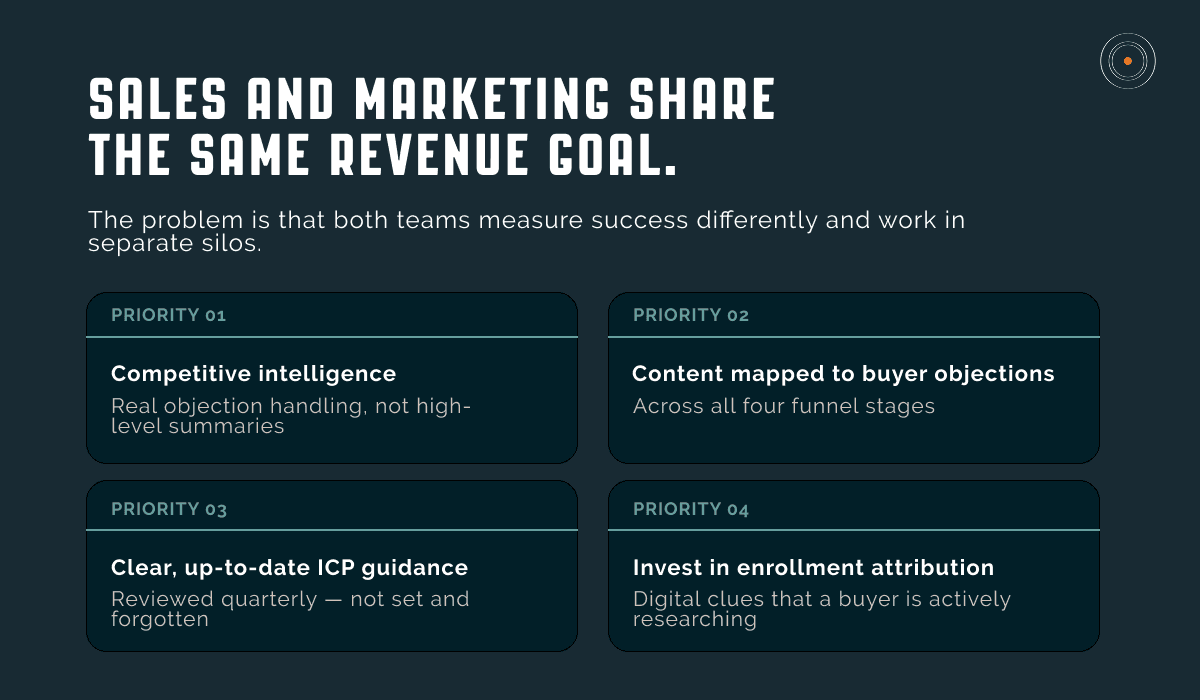
Although marketing and sales share the same revenue goals, issues arise when these teams work in separate silos. This breeds an inherent disconnect where different priorities and success metrics (not to be confused with a lack of competence) create friction.
Moving forward, we’ll have a close look at how the gap appears from the sales team’s perspective and how marketing leaders can help close it.
Central to all of this is an optimal B2B marketing and sales alignment strategy, shared revenue metrics for sales and marketing, an understanding of marketing qualified leads vs. sales qualified meetings, and more.
What Do B2B Sales Teams Actually Need From Marketing Teams?
B2B sales teams need competitive intelligence, content mapped to buyer objections, up-to-date ICP guidance, and account-level intent signals from marketing teams.
Each of these components is a critical asset that supports an optimal B2B marketing and sales alignment strategy, while helping sales teams move active opportunities forward.
What Resources Help Sales Win More Conversations?
The following four resources help sales win more conversations:
- Competitive intelligence that supports real objection handling (not high-level competitor summaries).
- Content mapped to buyer objections throughout the buying journey.
- Clear, up-to-date Ideal Customer Profile (ICP) guidance.
- Account-level intent signals that help prioritize outreach.
Marketing teams should treat ICPs as descriptions of buyers receiving maximum product value, while also giving maximum value to your brand.
Likewise, intent signals should be treated as digital clues that indicate a buyer is researching your business’ core offerings.
B2B sales teams need marketing teams to provide content that supports buyers at all four funnel stages:
- Early-stage education
- Mid-stage comparison
- Late-stage objections
- Final purchasing concerns
Which Marketing Outputs Often Miss the Mark for Sales Teams?
Generic collateral, SEO blog content, and MQL reporting are marketing outputs that often miss the mark for sales teams. These outputs don’t pose inherent threats to an optimal B2B marketing and sales alignment strategy. However, they simply aren’t the assets that sales teams need during live conversations.
This tension between marketing outputs vs. what sales actually needs is easily traced back to B2B lead quality vs. quantity. Traditionally, MQL reporting prioritizes high volumes of low-intent leads. Yet, sales teams need high-intent assets in order to close critical deals.
In this context, MQLs should be treated as signals or engagement indicators, rather than sales-ready leads.
| Marketing Produces | Why Sales Often Doesn't Use It | What Helps More |
|---|---|---|
| Generic collateral | Doesn't answer nuanced buyer questions | Objection-focused talk tracks |
| SEO blog content | Optimized for search rather than conversations | Buyer-question content |
| MQL reporting | Measures activity, not revenue impact | Pipeline quality and sales insights |
What Does Effective Marketing and Sales Collaboration Actually Look Like?
An effective marketing and sales collaboration looks like continuous feedback loops where sales conversations drive future content, both teams share ownership of ICP and messaging, while marketing builds talk tracks from real buyer objections.
This collaboration opens the door to an effective B2B marketing and sales alignment strategy where revenue generation becomes a shared, data-driven cycle. At the helm is not just continuous feedback, but also shared revenue metrics for sales and marketing.
Why Can Agencies Reinforce the Problem Instead of Solving It?
Agencies can reinforce problems between sales and marketing because these agencies often inherit existing silos.
Rather than streamlining an effective B2B marketing and sales alignment strategy, agencies may unintentionally hinder it by optimizing for traffic, leads, impressions, or campaign delivery. This then widens the gap between both teams, especially when sales outcomes aren’t valued as success measurements.
ZGM takes a different approach from the outset, unifying agency work with sales conversion quality and pipeline outcome. With this fundamental structural shift, we build a B2B marketing and sales alignment strategy around shared revenue metrics for sales and marketing.
Which Five Questions Should Every Marketing Leader Ask Their Sales Team This Week?
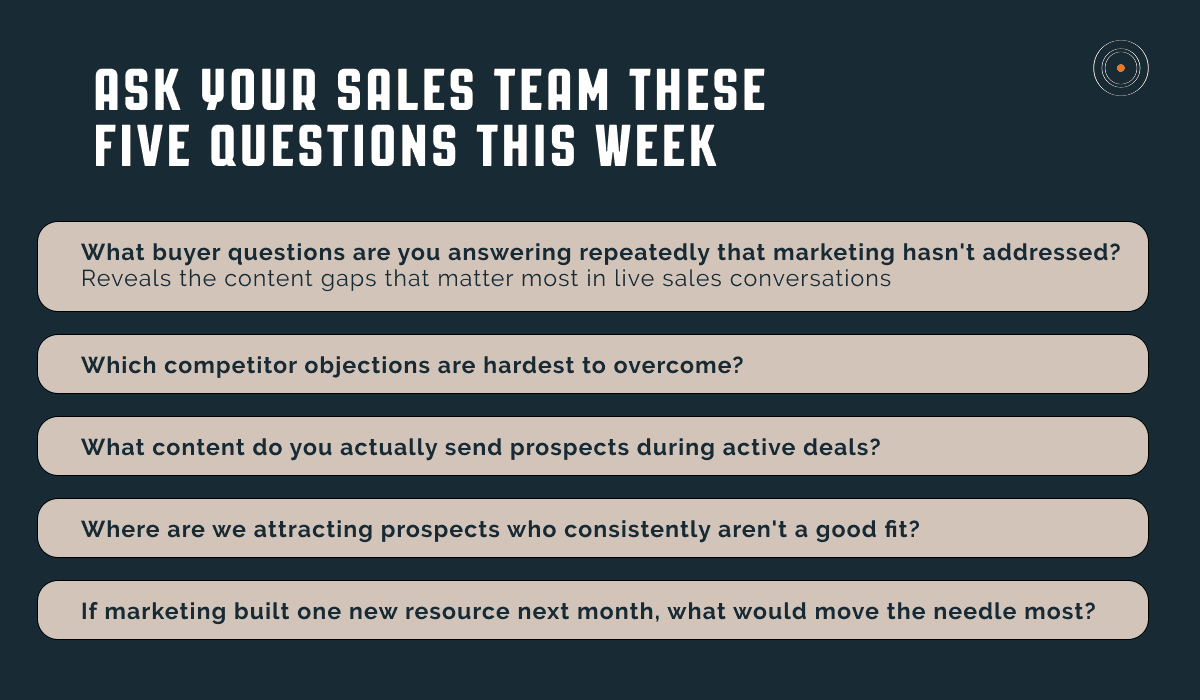
This week, every marketing leader should ask their sales team five questions that identify existing gaps and foster a path to practical alignment.
Here is that five-question diagnostic:
- What buyer questions are you answering repeatedly that marketing hasn't addressed?
- Which competitor's objections are hardest to overcome?
- What content do you actually send prospects during active opportunities?
- Where are we attracting prospects who consistently aren't a good fit?
- If marketing could create one new resource next month, what would make the biggest difference?
Conclusion
Understanding what B2B sales teams actually need from marketing isn’t about pitting these teams against one another. To the contrary, it’s about fostering a B2B marketing and sales alignment strategy.
With this strategy, both teams should see better buyer conversations, rather than simply producing more content or stronger top-of-funnel metrics.
Source: Gartner
At ZGM, we’re well-versed in helping brands measure success by pipeline impact and revenue, instead of just marketing activity in isolation.
Book a call with us today to see how ZGM aligns marketing strategy to sales outcomes.