



The hidden cost of winning bad-fit clients isn’t just churn, but also the compounding effects of internal distractions, reputational dilution, scope creep, and overservicing. For B2B businesses, simply winning more leads isn’t the goal…but rather winning the right leads is.
The bottom line? When you don’t filter out bad-fit clients, B2B cost, ICP discipline, lead quality, and conversions all take hits. On the other hand, ICP-disciplined lead generation builds qualification into marketing, thus allowing sales, delivery, and retention to improve over time.
Introduction
At ZGM, we see this all too often: a company has seemingly growing revenue, yet can’t stop hemorrhaging margins and team time, while closing new deals just generates friction. It’s tempting to blame this on sales or client success.
In actuality, the problems and cost of bad-fit clients usually begin before the first sales call. Enter lead generation.
Many agencies fail to realize how much bad-fit clients (B2B) cost. ICP discipline, lead quality, and overall team morale suffer considerable blows. Moving forward, we’ll explore exactly what this means, how to achieve ICP-disciplined lead generation, and why sales and marketing alignment is so essential.
What Does a Bad-Fit Client Really Cost?
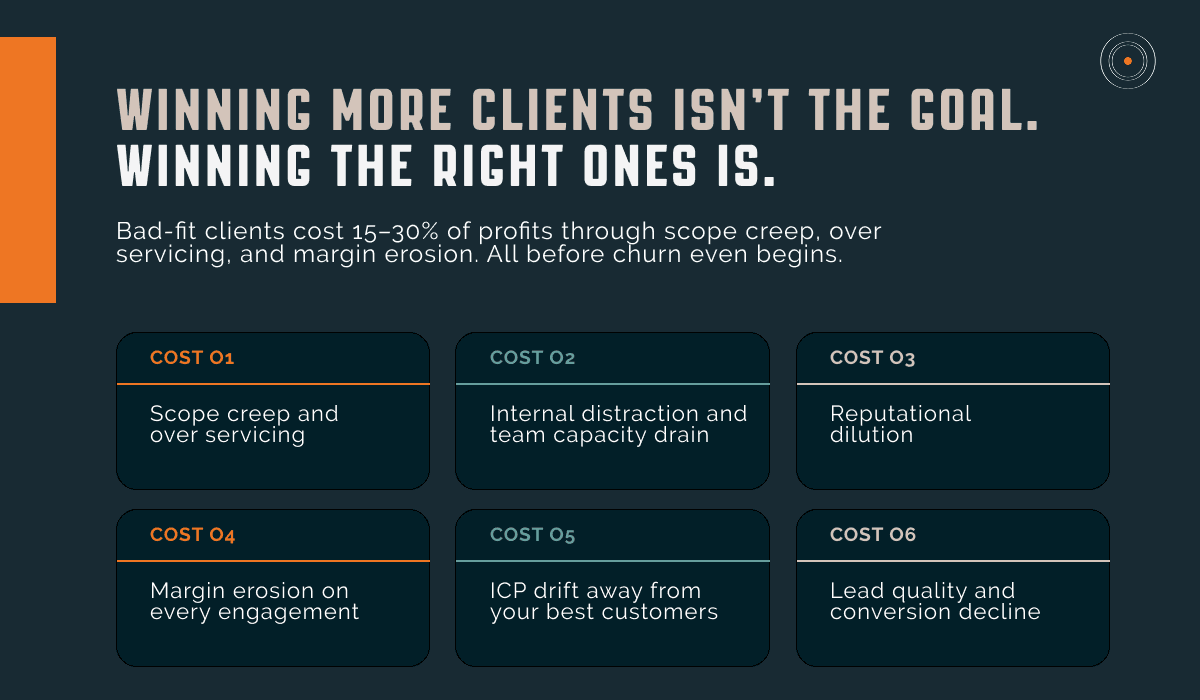
The cost of bad-fit clients is over-servicing, scope creep, internal distraction, reputational dilution, team capacity, and margin erosion. Despite their hidden nature, these costs rapidly exacerbate over time.
According to Iota Finance, the average service firm loses 15% to 30% of profits to misaligned pricing, subpar time tracking, and unbilled scope creep. This only underscores the many problems posed by bad-fit clients (B2B cost, ICP discipline, lead quality decline, and lost revenue).
To avoid bad-fit clients, B2B businesses should have a clear understanding of the ideal customer profile (ICP). The ICP is a clearly defined description of companies most likely to generate long-term value, rather than merely becoming customers.
Why is Client Fit a Marketing Problem Before It's a Sales Problem?
Client fit is a marketing problem before it’s a sales problem because marketing determines which clients enter the funnel. Because of this, when companies don’t filter out bad-fit clients, B2B cost, ICP discipline, lead quality, and conversions all move in the wrong direction.
Broad targeting produces broad-fit prospects, which isn’t always as good as it seems. All too often, companies confuse “hard to serve” clients with clients who were always the wrong fit.
Eventually, this can lead to ICP drift, where a company’s target profile starts moving away from its ICP.
In our experience at ZGM, most B2B businesses don’t see this happening in real time.
| Hard to Serve | Wrong From the Start |
|---|---|
| Temporary friction | Poor fit from Day One |
| Expectations can align | Expectations were never aligned |
| Service challenge | Qualification challenge |
What Does ICP-Disciplined Lead Generation Actually Look Like?
ICP-disciplined lead generation looks like building qualification into marketing. On an operational level, this requires ICPs that are specific enough to target real accounts.
Criteria must be set for qualification and disqualification, along with sales and marketing alignment on the definition of which customer profiles are a fit.
ICP-disciplined lead generation also requires content that attracts the right customer profiles, while repelling the wrong ones. Finally, businesses should implement quarterly ICP reviews that include retention, churn, and expansion data.
How Can You Tell If Your Lead Generation is Producing Fit or Just Volume?
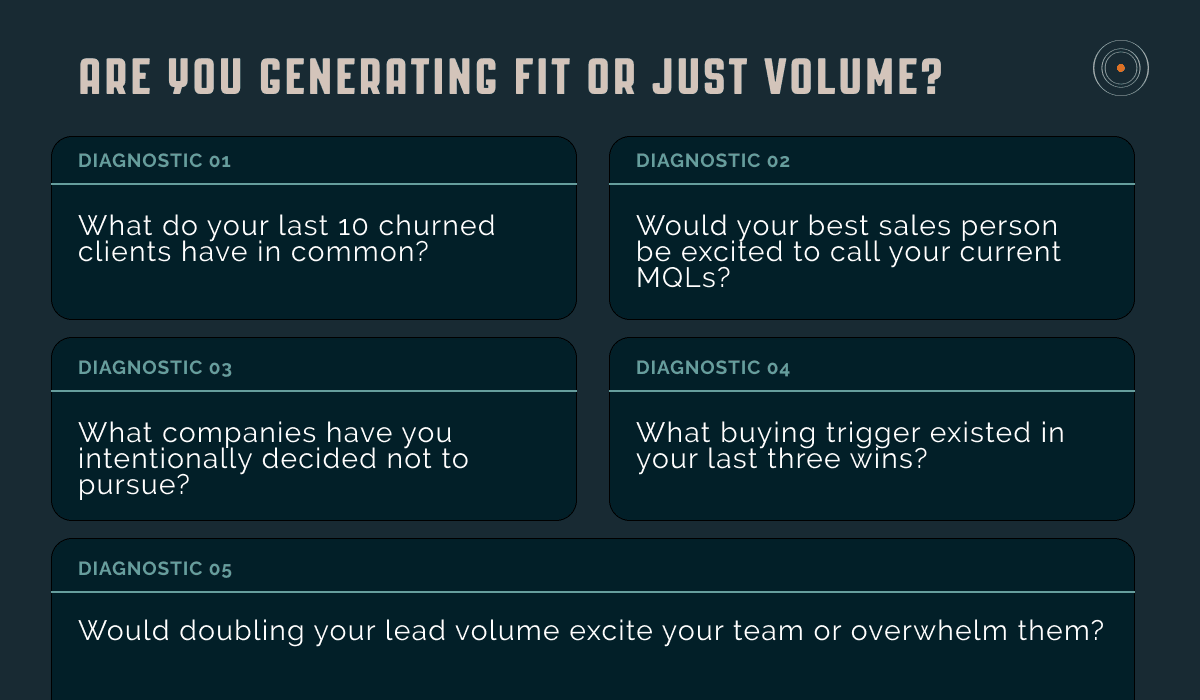
Marketing leaders can tell if lead generation is producing fit or just volume by using a five-question diagnostic.
Here’s what those questions look like:
- What do your last 10 churned or hardest-to-serve clients have in common?
- Would your best salesperson be excited to call your most current MQLs?
- What companies have you intentionally decided not to pursue?
- What buying trigger existed in your last three wins?
- Would doubling lead volume excite or overwhelm your team?
With this five-question diagnostic, you can avoid the many problems associated with bad-fit clients (B2B cost, ICP discipline, lead quality deterioration, and low conversions).
Final Thoughts
ICP-disciplined lead generation doesn’t mean maximizing volume. It means attracting high-quality leads that your business can profitably serve over time. That’s what ultimately determines if you’re absorbing vs. avoiding the cost of bad-fit clients.
Source: Harvard Business Review
At ZGM, we’ve seen firsthand how bad-fit clients hurt businesses. If you’re generating leads but not the right ones, let’s look at what’s driving that. Book a call with us today to get started.