


Transfer student recruitment has become the smartest play in enrollment marketing because of the declining college-aged population. With this shift, transfer students are now one of the most valuable, yet overlooked, enrollment opportunities.
Moving into 2027, directors must lean into an effective transfer student enrollment marketing strategy. Doing so helps institutions wield targeted messaging, programmatic advertising, and a transfer-focused media mix to reach high-intent students.
This shift isn’t about replacing traditional enrollment efforts. Rather, it’s about strengthening these efforts via college credit transfer evaluation tools, transfer student scholarship incentives, and other recruitment strategies.
Introduction
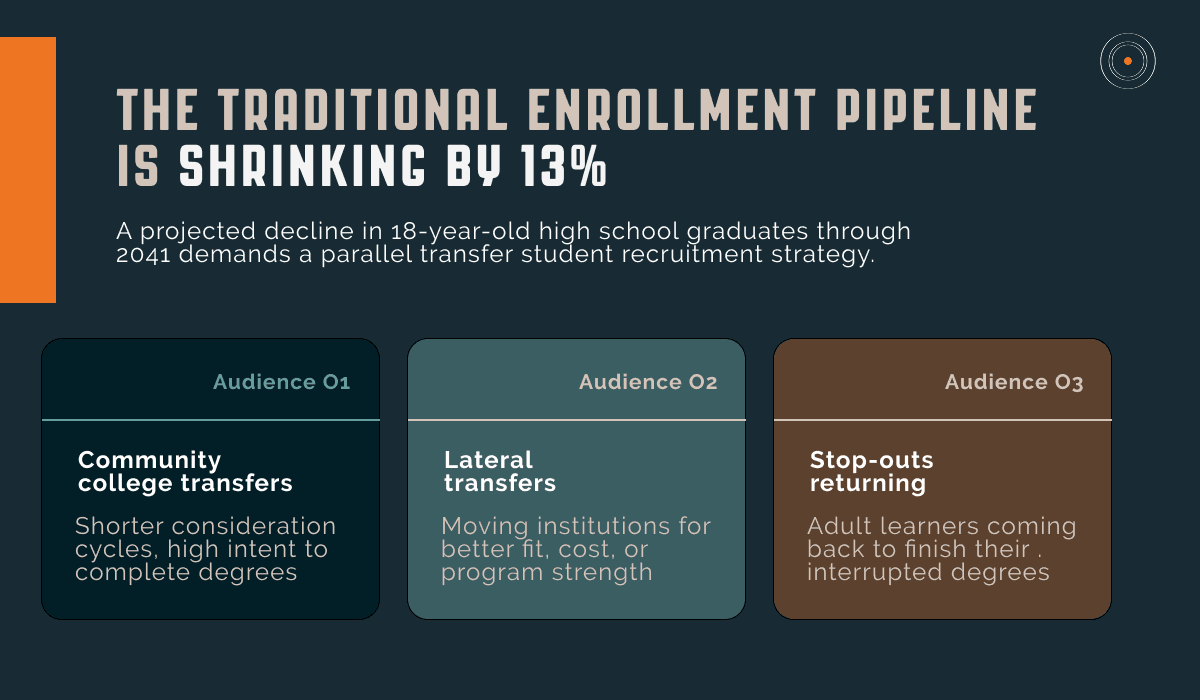
As we speak, the number of traditional, 18-year-old high school graduates is rapidly shrinking. Through at least 2041, there’s a 13% projected decline, per Forbes.
To plug the gap, institutions must start investing in transfer students. Whether they’re community college transfers, lateral transfers, or returning stop-outs, this demographic is a growing one. It’s also significantly less competitive than traditional 18-year-olds.
Moving forward, directors should see transfer recruitment (and by extension, an optimal transfer student enrollment marketing strategy) as mandatory, not merely an afterthought or secondary campaign.
Why Should Enrollment Leaders Prioritize Transfer Student Recruitment?
Enrollment leaders should prioritize transfer student recruitment due to the projected 13% decline in 18-year-old high school graduates.
This demographic cliff demands a transfer student enrollment marketing strategy that targets community college transfers, lateral students, and stop-outs coming back to finish their degrees.
Competition for transfer students (young people transferring from one institution to another to finish their degrees) is often lower. That’s due to shorter consideration cycles, more rational decision-making criteria, alongside different emotional drivers and informational necessities.
As a complementary approach to traditional recruitment, the right transfer student enrollment marketing strategy offers a prompt, high-yield hedge against the demographic cliff.
How is Transfer Student Marketing Different from Freshman Recruitment?
Shorter decision timelines, more practical decision-making, and alternate messaging priorities make transfer student marketing different from freshman recruitment.
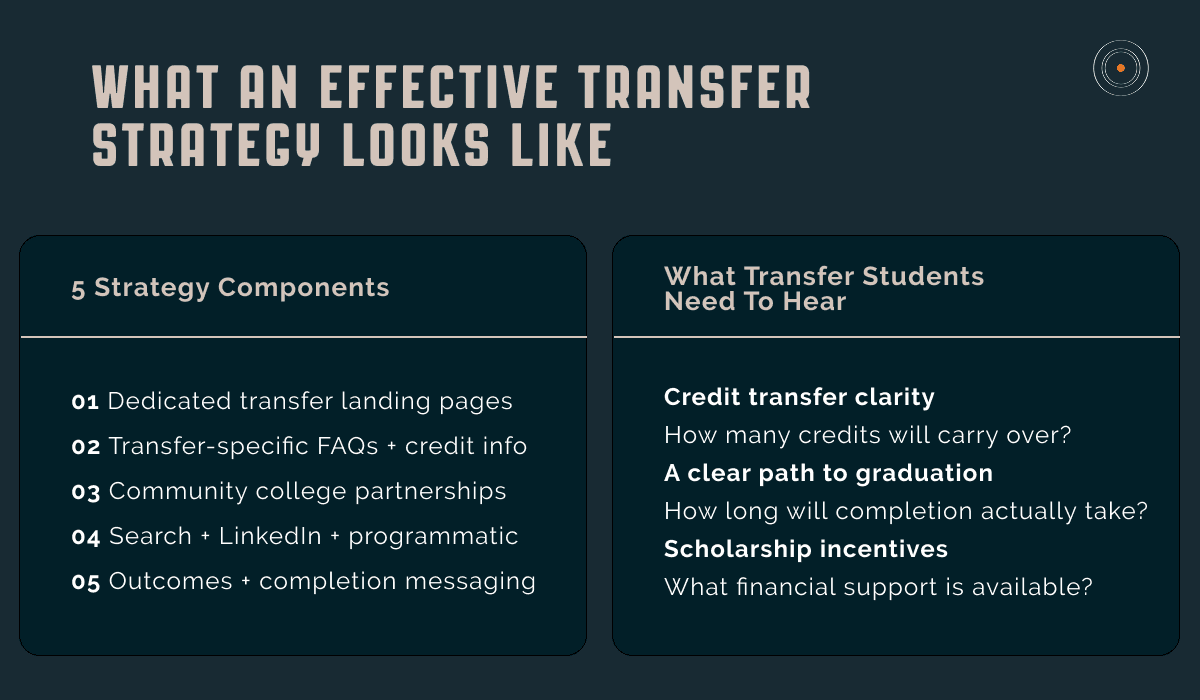
Validation generally trumps aspiration. Likewise, transfer students are more focused (than 18-year-old high school graduates) on credits carrying over from previous institutions, potential losses, and seeing a tangible path to graduation.
Shorter decision timelines
As directors craft a transfer student enrollment marketing strategy, they should realize these students generally need quick transfers. For this reason, marketing must prioritize transfer student scholarship incentives, college credit transfer evaluation tools, and other components that support efficient, informed choices.
More practical decision-making
In addition to credit transfers and graduation timeframes, transfer students also take cost and scheduling flexibility into account. Directors that incorporate community college articulation agreements and other incentives into their marketing can increase enrollment. Long-term, this helps plug a growing vacancy created by the demographic cliff.
Different messaging priorities
Given the importance of validation and clear answers over aspiration and brand storytelling, directors’ transfer student enrollment marketing strategy must center the former. This means going for dedicated transfer content instead of repurposed freshman pages.
| Freshman Recruitment | Transfer Recruitment |
|---|---|
| Campus experience | Credit transfer & degree completion |
| Student life | Career outcomes |
| Long research cycle | Short decision timeline |
| Aspirational messaging | Outcome-focused messaging |
What Does an Effective Transfer Recruitment Strategy Look Like?
An effective transfer recruitment strategy looks like a blend of transfer-focused media mix, programmatic advertising, and outcome-oriented messaging.
This requires an optimal transfer student enrollment marketing strategy to include five key components:
- Dedicated transfer landing pages
- Transfer-specific FAQs and credit information
- Community college partnerships
- Search and LinkedIn alongside traditional digital channels
- Messaging centered on outcomes and completion
Going into 2027, programmatic advertising should be a part of any transfer student recruitment strategy. In order to reach transfer prospects (community college students, adult learners, stop-outs, or even working professionals) with high enrollment intent, institutions need to build audiences based on behavioral and demographic signals.
Programmatic advertising within a transfer student enrollment marketing strategy, more often than not, yields precise targeting in ways that traditional campaigns often miss.
How Can Universities Strengthen Enrollment by Recruiting Freshmen and Transfer Students in Parallel?
With dedicated messaging, budgets, and performance measurement for freshmen and transfer students, universities can strengthen enrollment across both audiences in parallel.
Optimizing a transfer student enrollment marketing strategy isn’t about replacing freshmen recruitment. On the contrary, it’s about complementing freshmen recruitment amid the well-documented demographic cliff.
Moving forward, enrollment directors should bring a four-step plan to institutional leadership:
- Audit current transfer marketing assets.
- Create transfer-specific messaging and landing pages.
- Invest in channels that reach transfer audiences.
- Measure transfer recruitment separately from freshman campaigns.
Conclusion
Amid a projected 13% decline in 18-year-old high school graduates, transfer students are a distinct group that institutions must tap into. With disparate motivations and decision-making processes than freshmen, a transfer student enrollment marketing strategy is no longer optional.
Source: Western Interstate Commission for Higher Education
Moving forward, enrollment leaders should treat transfer recruitment as a parallel, long-term investment into their broader enrollment marketing plan.
Not sure where to begin? Book a call with us today and talk to ZGM about building a transfer student recruitment strategy.