



From consumer brand strategy, enrollment marketing directors can learn to integrate persona-driven execution (especially via programmatic) alongside campaign performance. This hybrid approach creates preference before students ever click on an ad.
Persona-driven execution doesn’t just make performance marketing more effective. It also streamlines a competitive enrollment marketing strategy for higher education in today’s landscape. Heading into 2027, optimizing campaigns like a B2B lead generation engine simply isn’t tenable anymore.
Remember, as directors move to find the right enrollment marketing strategy, higher education institutions are operating within a shrinking market. This makes the stakes more critical than ever for enrollment teams, which only further underscores the importance of consumer brand strategy.
Introduction
Picture this: Two universities target the same prospective student. Both have similar channels, messaging, and budgets. Guess which university the student picks?
It’s not the one with a slightly better ad. It’s the university they’ve had months of ambient exposure to and thus come to trust.
Across higher education marketing trends, you’ll notice that campaign performance has traditionally been prioritized. Now, contrast that with consumer brands that’ve built entire marketing disciplines around influencing buyer preference.
The next evolution isn’t about fully choosing one approach over the other. It’s about optimizing campaign performance while simultaneously influencing consumer preference.
Why is Consumer Brand Strategy Becoming More Important for Enrollment Marketing?
Consumer brand strategy is becoming more important for enrollment marketing because awareness emerges first in the funnel. This directly correlates to preference, thus driving student enrollment rates.
Amid a rising student acquisition cost (higher ed), directors must understand why enrollment marketing has historically favored B2B lead generation.
At the helm of this are inquiries, applications, funnel optimization, and measurable ROI. Each of these KPIs goes hand-in-hand with more conversions. Though critical vulnerabilities emerge when directors focus on these metrics in isolation, without also prioritizing consumer brand strategy.
Conversion requires brand preference because optimized funnels alone don’t convert students. Brand positioning (defining and communicating the university’s unique value proposition) that’s targeted towards specific audiences is what ultimately drives student conversions.
| B2B Lead Generation | Consumer Brand Strategy |
|---|---|
| Funnel velocity | Brand preference |
| Campaign-first | Positioning-first |
| Volume metrics | Awareness + preference |
| Broad messaging | Audience-specific messaging |
What Can Enrollment Marketing Teams Learn from Consumer Brands?
Understanding audiences before choosing tactics is a pivotal strategy that enrollment marketing teams can learn from consumer brands.
As directors optimize their enrollment marketing strategy, higher education students must be recognized as unique audiences with different psychographic and behavioral segmentations. From this point onward, brand positioning investments and consumer brand strategy measurements become essential.
1. Treat prospective students as distinct audiences
Treating prospective students as distinct audiences means going beyond demographics.
Psychographic and behavioral segmentation (think first-generation students, flagship comparison shoppers, and graduate students) should be carefully considered as directors craft the right enrollment marketing strategy for higher education.
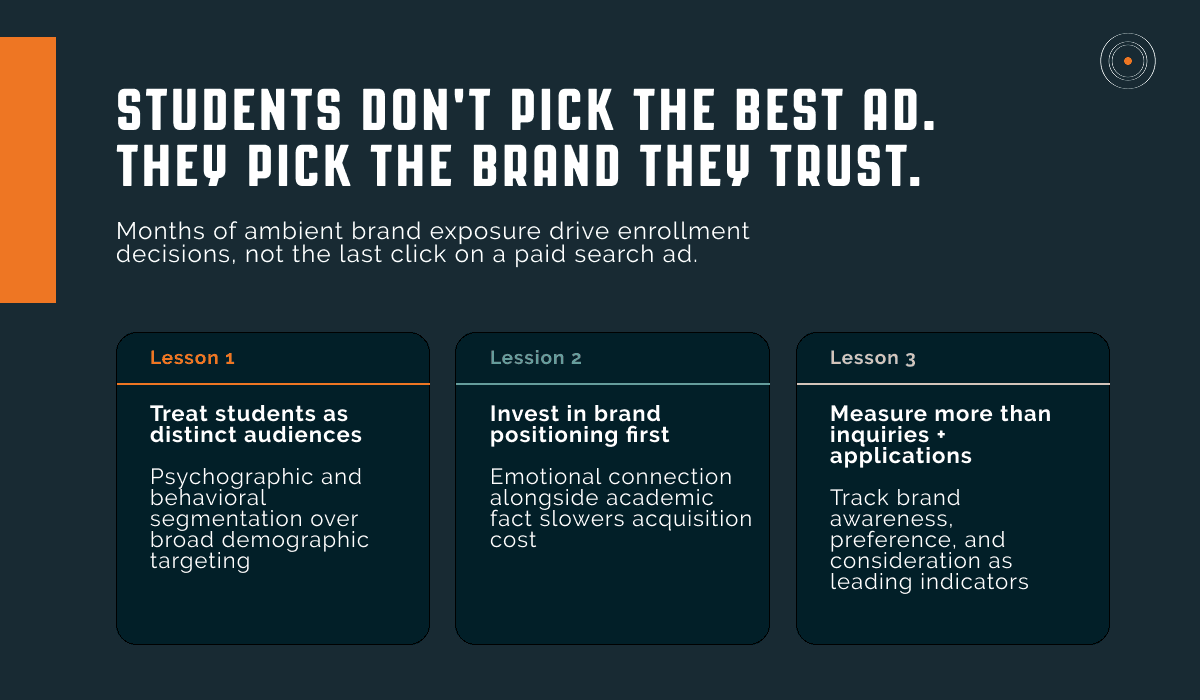
By recognizing these distinct audiences, directors can use deeper insights to move from generic outreach to segmented marketing. This, in turn, facilitates studying behavioral cues while ensuring the right groups see target messaging that connects with their needs.
At its core, psychographic segmentation means using internal psychological traits, rather than external facts, to divide prospective students.
2. Invest in brand positioning before launching campaigns
Just as brand positioning influences each campaign, emotional connections with audiences should appear in tandem with academic facts.
Amid teams developing the right enrollment higher education marketing strategy, they must realize that institutional branding does a lot of heavy lifting.
From pre-selling the institution and validating academic facts to deepening emotional ties via macro branding and lowering acquisition costs, this all builds long-term trust and perception.
3. Measure more than inquiries and applications
When optimizing an enrollment marketing strategy for higher education, teams should measure leading indicators of student conversion. At the top of the list are brand awareness, brand preference, and consideration.
Foundational to the top and mid funnel, these indicators fuel early visibility among prospective students. They likewise provide reliable forecasts of future application volume weeks (or even months) in advance.
How Can Programmatic Advertising Turn Brand Strategy into Action?
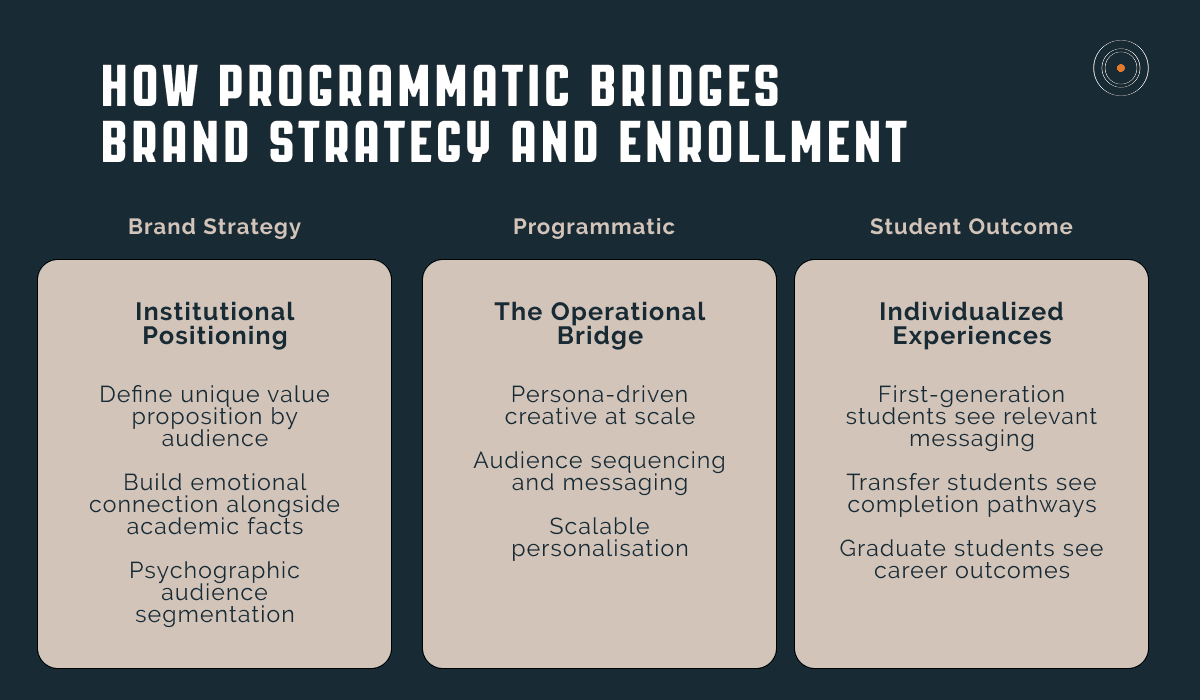
Programmatic advertising turns brand strategy into action by providing segmented, personalized messaging at scale. That isn’t just uniquely suited to consumer-brand thinking. It’s also largely untapped in higher education.
As 2027 gets closer, teams are best served by implementing programmatic advertising into their higher education enrollment marketing strategy. This first affords room for persona-driven creative, scalable personalization, audience segmentation, and messaging sequences.
From here, directors can begin institutional optimization. Students (whether first generation, transfer, out-of-state, or graduate) receive customized, culturally relevant messaging that aligns with their paths. This then increases funnel efficiency and conversions.
At its core, programmatic advertising works as the operational bridge translating institutional strategy into individualized student experiences.
Why Does This Shift to Consumer Brand Strategy Matter More Now Than Ever?
The shift to consumer brand strategy matters now more than ever because of shrinking student populations and increasing competition.
As directors update their enrollment marketing strategy within higher education, they must know that distribution in isolation won’t create differentiation. Likewise, more impressions on the same messaging won’t deliver the results of consumer brand strategy.
At their core, strong brands that use programmatic advertising make every marketing dollar work harder. Per Basis Technologies, programmatic advertising yields significant ROI as universities navigate the enrollment cliff and increasing selectivity among prospective students.
Conclusion
When optimizing an enrollment marketing strategy, higher education doesn’t have to replace performance marketing. On the contrary, it should strengthen performance marketing via consumer brand strategy.
Moving into 2027, institutions that build brand awareness before prospective students enter the funnel will enjoy a competitive edge. Amid an increasingly challenging enrollment landscape, analyzing higher education marketing trends (and how consumer brand strategy converts leads) isn’t optional.
Source: Inside Higher Ed
At ZGM, we’ve seen the firsthand benefits of consumer brand strategy connecting with a shrinking pool of students. Book a call with us today to see how ZGM approaches enrollment marketing strategy.