



TL;DR
In light of the current enrollment cliff, your 2027 marketing budget should factor in universities competing for fewer students as acquisition costs continue to rise.
The best enrollment cliff marketing budget strategy in 2027 must accommodate a shrinking (and more competitive) pool. Likewise, institutions will find themselves best served by reallocating spending towards conversion, attribution, AI enrollment marketing tools, and full-funnel strategies that improve student sign-ups.
The current enrollment cliff isn’t just a demographic trend.
It’s also a budgeting challenge that requires institutions to become more tactical with student enrollment optimization. A more congruent approach to implementing the most efficient higher education digital marketing strategy likewise remains critical.
Moving forward, we’ll do a deep dive into how enrollment marketing directors must respond to structural changes. We’ll also explain how this factors into the best enrollment cliff marketing budget strategy in 2027.
What Does the Enrollment Cliff Actually Mean for Your Marketing Budget?
The enrollment cliff (a sudden, sharp decline in available, college-aged young people) means this: your marketing budget must adapt to shrinking student volumes, rising acquisition costs, and more pressure to demonstrate ROI.
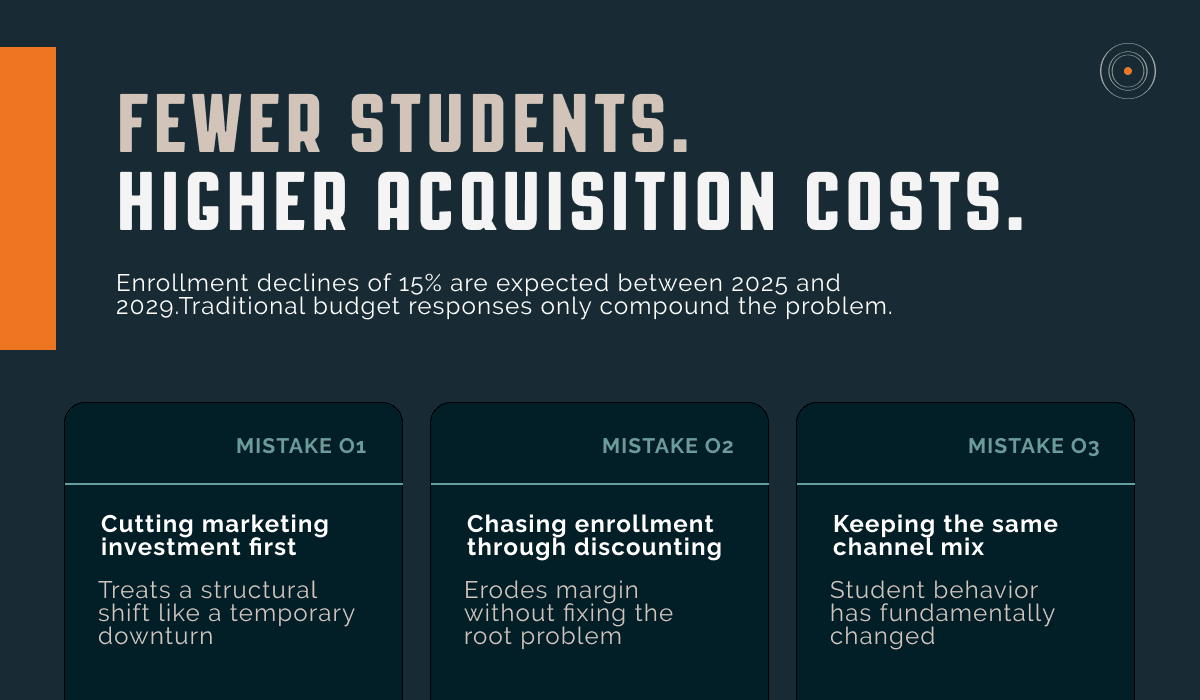
According to Carleton College economist Nathan Grawe, enrollment declines are expected to drop by 15% between 2025 and 2029. Going into 2027, universities face an increasingly competitive landscape where traditional budget responses only compound existing problems.
Why Aren't Traditional Budget Responses Working?
Traditional budget responses are not working because they treat permanent demographic structural shifts as a temporary economic downturn. This isn’t only misaligned with the right enrollment cliff marketing budget strategy in 2027. Missing the enrollment cliff’s high stakes also reduces competitiveness in a shrinking market.
Here are the three most common mistakes institutions make in response to the enrollment cliff:
- Cutting marketing investment first
- Chasing enrollment through discounting
- Keeping the same channel mix despite changing student behavior
Which Marketing Investments Should Institutions Prioritize for 2027?
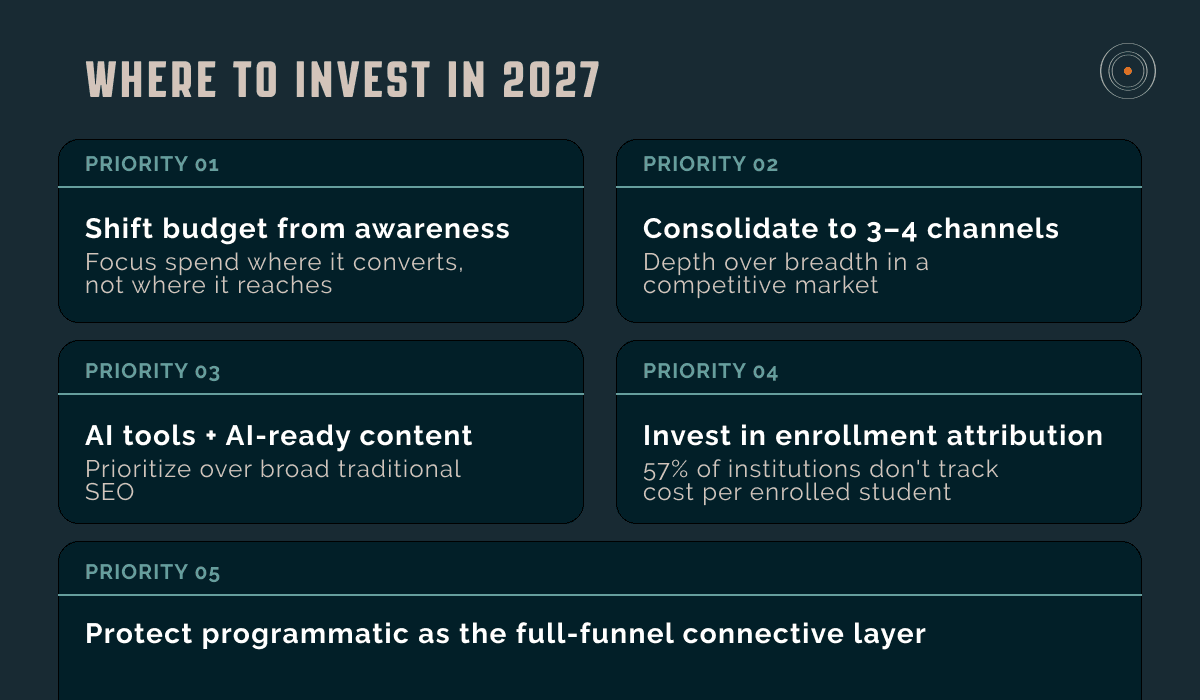
Forward-thinking institutions should prioritize five key marketing investments for student enrollment optimization amid the enrollment cliff.
Here’s what those investments look like:
- Shift budget from awareness to conversion
- Consolidate spending into three to four proven channels
- Prioritize AI enrollment marketing tools and AI-ready content over broad traditional SEO
- Invest in enrollment attribution
- Protect programmatic as the full-funnel connective layer
According to the UPCEA and Search Influence, 57% of institutions fail to track cost per enrolled student by channel.
How Are Forward-Thinking Enrollment Leaders Planning Differently?
Forward-thinking enrollment leaders are planning differently by adjusting their enrollment cliff marketing budget strategy for 2027.
Gone are the days of broad awareness campaigns moving the needle. To the contrary, institutions must shift towards personalized, data-driven recruitment that combats shrinking student pools.
| Traditional Approach | 2027 Approach |
|---|---|
| Cut marketing first | Reallocate strategically |
| Focus on inquiry volume | Focus on cost per enrolled student |
| Spread budget across many channels | Invest deeply in proven channels like programmatic |
| Treat attribution as optional | Invest in measurement and full-funnel strategy |
What Should Enrollment Marketing Directors Do Before Finalizing Their 2027 Budget?
Before enrollment marketing directors finalize their 2027 budget, they should fully understand that proactive reallocation is better (and less costly) than rebuilding lost enrollment pipelines later.
This makes the following prerequisites essential for any finalized enrollment cliff marketing budget strategy in 2027:
- Auditing current channel performance
- Shifting spending toward conversion and measurable ROI
- Investing in attribution and AI-ready content
- Protecting full-funnel programmatic investment
Final Thoughts
The present-day enrollment cliff constitutes a budgeting challenge while simultaneously posing a demographic challenge. When institutions rethink (rather than merely reduce) their 2027 marketing investment strategy, they’re streamlining long-term student enrollment optimization even in a highly competitive landscape.
Source: EAB’s 2026 Higher Ed Marketing Outlook
At ZGM, we’re well-versed in helping enrollment leaders thrive amid structural institutional pressures. Book a call with us today and let’s talk about how to build a 2027 enrollment marketing strategy that works in this environment.