



Higher ed marketing budgets get cut when marketing’s contribution to enrollment isn’t clear (not because the economy is weak). When it comes to higher education marketing budget justification, enrollment outcomes (not marketing activity) should be the focus of reporting.
Barring visible, tangible higher ed marketing ROI, marketing starts looking like a cost center. That ultimately leads to budget cuts. The bottom line? Protecting future budgets means reporting on the metrics that executives consider when evaluating institutional performance.
Introduction
In 2026, many enrollment CMOs understandably feel frustrated when budgets get cut notwithstanding strong campaign performance. Amid higher education budgeting justification, enrollment outcomes being treated as underlying factors is often overlooked, despite being a primary reason behind said reductions.
One of the most common misconceptions is that broader economic problems drive budget cuts. In actuality, the real issue lies in how marketing value gets internally communicated.
Moving forward, we’ll explore why an updated approach to reporting is imperative to preventing future, unjustified budget cuts.
Why Do Higher Education Marketing Budgets Get Cut Even When Marketing Is Performing Well?
Higher education marketing budgets get cut (even when marketing is performing well) due to a disconnect between marketing success and executive perception. That matters.
In this context, when navigating higher education marketing budget justification, enrollment outcomes, not campaign activity, are what gets evaluated by leadership. When student enrollment yield suffers or goes unreported, executives are generally more inclined to cut marketing budgets.
This disconnect ultimately boils down to a systemic reporting issue, rather than marketing team failures. To remedy the problem, marketing teams must know what enrollment outcomes actually are. They must also understand why traditional marketing reports fail to give leadership what they need.
Enrollment outcomes are measurable institutional results, such as tuition revenue, filled seats, and student enrollment yield.
Why Don't Traditional Marketing Reports Give Leadership What They Need?
Traditional marketing reports don’t give leadership what they need because the reports’ metrics optimize campaigns without answering executive leaders’ primary question:
What did marketing contribute to enrollment and how much did it cost per seat?
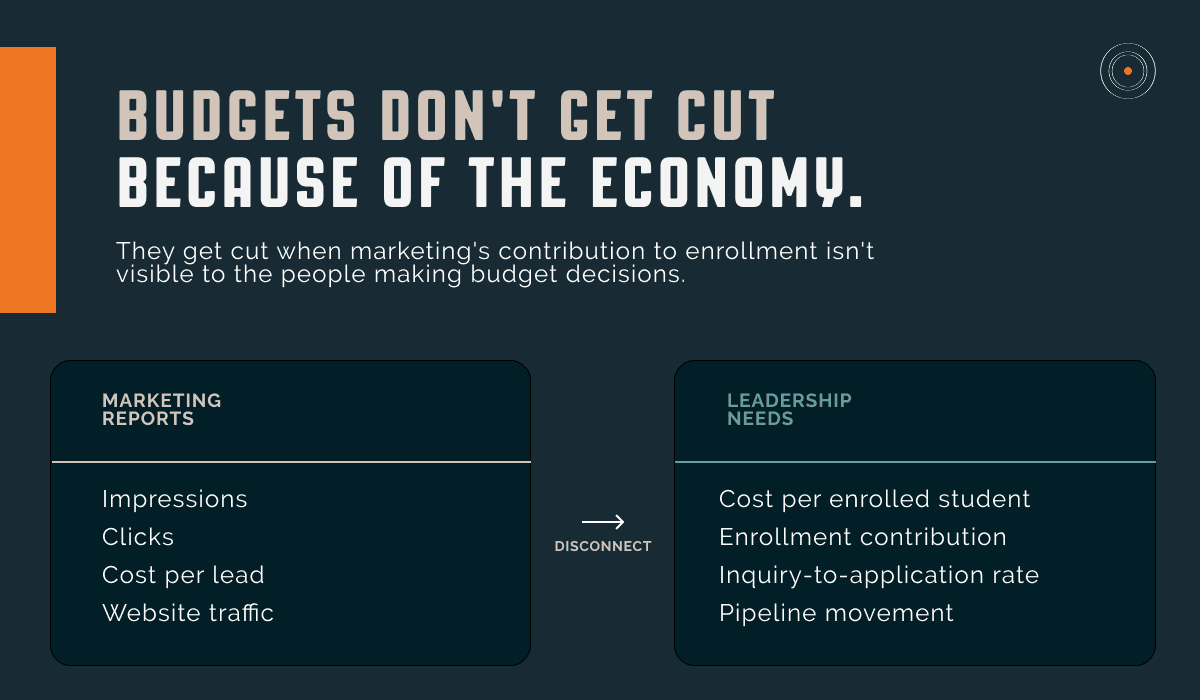
When considering higher education marketing budget justification, enrollment outcomes should be at the forefront of marketing teams’ minds. Instead, they all too often focus on the following, tactical campaign metrics:
- Impressions
- Clicks
- Cost per lead
- Website traffic
These metrics might look good on paper, but they ultimately fail to convey higher ed marketing ROI to executives.
| Marketing Reports Often Highlight | Leadership Wants to Understand |
|---|---|
| Impressions | Cost per enrolled student |
| Clicks | Enrollment contribution |
| Cost per lead | Inquiry-to-application conversion |
| Campaign activity | Pipeline movement toward enrollment |
Which Metrics Actually Protect Marketing Budgets?
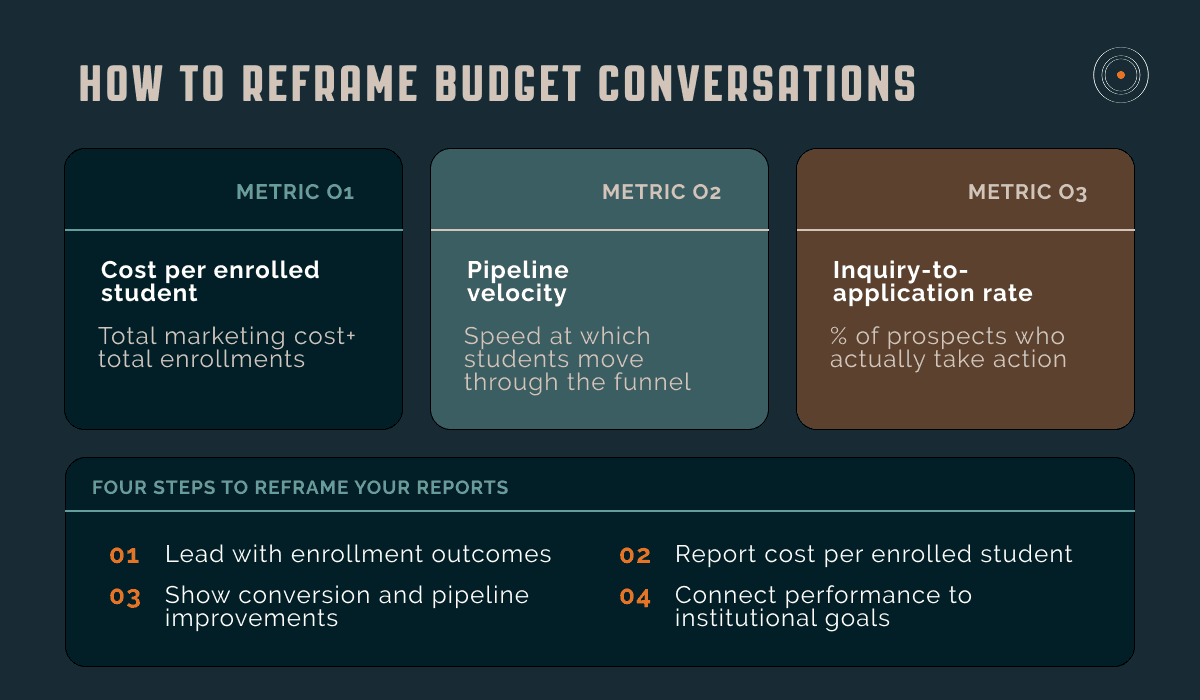
The metrics that actually protect marketing budgets are cost per enrolled student, pipeline velocity, and inquiry-to-application conversion rate.
What is Cost Per Enrolled Student and Why Does It Matter?
Cost per enrolled student is the total marketing cost divided by total enrollments.
This matters because amid higher education marketing budget justification, enrollment outcomes go hand-in-hand with how many dollars are necessary to acquire each student. Without marketing reports that highlight cost per enrolled student, leadership is more likely to cut budgets.
How Do Pipeline Velocity and Inquiry-to-Application Conversion Show Marketing Impact?
Pipeline velocity is the speed at which prospective students move through the enrollment funnel. This shows marketing impact insofar as faster speeds convey higher engagement with prospects applying in less time.
Inquiry-to-application conversion rate is the percentage of prospective students who actually apply. This shows marketing impact insofar as demonstrating that high-quality leads are taking action.
How Can Enrollment Marketing Leaders Reframe Budget Conversations?
Enrollment marketing leaders can reframe budget conversions by focusing on metrics that present marketing as a revenue driver, rather than a cost center.
Here’s what that looks like:
Before
- Reporting focuses on campaigns completed.
- Executives hear spending without business impact.
After
- Reporting focuses on enrollment contribution.
- Budget discussions become conversations about investment rather than expense.
Amid higher education marketing budget justification, enrollment outcomes shouldn’t be an afterthought.
To the contrary, teams should take the following steps to reframe marketing reports:
- Lead with enrollment outcomes.
- Report cost per enrolled student.
- Show improvements in conversion and pipeline efficiency.
- Connect marketing performance directly to institutional goals.
Why Does Better Reporting Change Future Budget Decisions?
Better reporting changes future budget decisions because consistent, outcome-focused reports build executive confidence. When it comes to higher education marketing budget justification, enrollment outcomes are necessary to demonstrate marketing as a revenue driver.
When teams conversely rely on activity-focused reporting, they’re unintentionally presenting marketing as a cost center. This, in turn, increases the likelihood of budget cuts.
Final Thoughts
In 2026, as teams navigate higher education marketing budget justification, enrollment outcomes should be used to demonstrate measurable impacts. Think higher ed marketing ROI and student enrollment yield.
Source: Higher Ed CMO Study
At ZGM, we’re proud to help institutions transition from reporting marketing activity to documenting institutional outcomes. Book a call with us today to see how ZGM builds enrollment marketing reporting that leadership can act on.