From banking apps to online shopping assistants, you’ve likely interacted with chatbots and conversational AI tools dozens of times without even realizing it. While these technologies often appear similar on the surface, they’re fundamentally different in how they work. Having the ability to understand those differences can help businesses, like yours, use them more effectively.
In this guide, our marketing experts will explain what chatbots and conversational AI are, break down their key differences, highlight real-world examples, and explore how they’re shaping the future of digital marketing.
Understanding the Types of AI You’re Chatting With
Before diving into comparisons, it helps to define what each technology actually is.
What Is a Chatbot?
A chatbot is a software application that simulates human conversation using rule-based programming or scripted flows. These tools are designed to handle straightforward tasks like answering FAQs, booking appointments, or providing basic product information.
Think about the “How can I help you today?” popup on an eCommerce site. When you select an option, the bot follows a predetermined decision tree to guide you toward a solution. Chatbots are fast, simple, and cost-effective, but they’re limited to the scenarios they’ve been programmed for.
What Is Conversational AI?
Conversational AI is a more advanced form of artificial intelligence that uses natural language processing (NLP), machine learning (ML), and often large language models (LLMs) to understand, interpret, and respond to human language. Unlike traditional chatbots, conversational AI doesn’t just follow a script, it learns and adapts over time.
For example, AI tools like ChatGPT or Google’s Gemini can process complex requests, remember context from earlier in the conversation, and provide nuanced, human-like responses. They can handle open-ended queries and even predict what users might ask next.
Key Differences Between Chatbots and Conversational AI
Although they both help users get answers, the way they operate and the experiences they deliver are very different.
How Each AI Model Type Handles Conversations
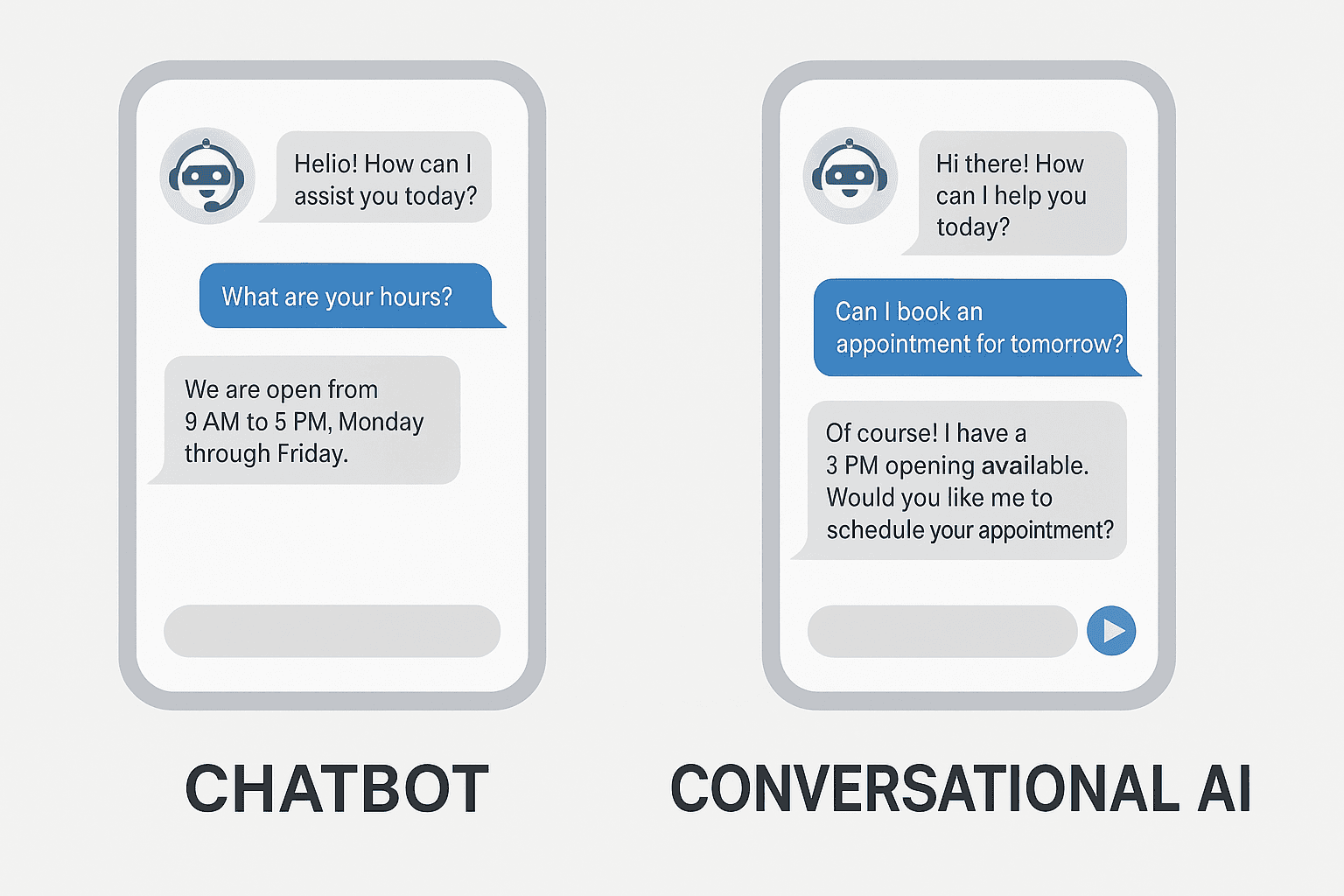
- Chatbots follow strict decision trees. If a question falls outside their programmed options, you’ll usually get a “Sorry, I didn’t understand that” response.
- Conversational AI uses NLP and ML to interpret intent, meaning it can handle more natural, unscripted conversations.
Example:
- A chatbot at a retail store might only recognize “Where’s my order?” and provide a tracking link.
- A conversational AI system could understand a vague question like “I ordered shoes last week, can you check when they’ll get here?” and pull your order details dynamically.
The Ability to Learn and Adapt
Chatbots are static. Once they’re programmed, they stay the same until a developer updates their scripts.
Conversational AI, on the other hand, learns from every interaction. Over time, it refines its understanding of language and customer preferences, improving accuracy and personalized results.
Where User Experience and Personalization Come In
Personalization is the real differentiator.
A conversational chatbot powered by AI can tailor recommendations based on purchase history, browsing behavior, or even tone of voice. For example, an airline using conversational AI could proactively suggest flight upgrades or faster check-in options based on frequent travel patterns (something traditional chatbots can’t do.)
Where You May Run Into Each AI Model
Both technologies are everywhere, but they show up in different ways.
Common Chatbot Use Cases
- FAQ widgets on websites
- Automated help desks
- Appointment booking flows
- Simple lead generation forms
For example, a local dentist might use a chatbot to confirm appointments or provide quick answers about office hours.
Conversational AI in Action
- Virtual assistants like Siri, Alexa, or Google Assistant
- AI-driven customer service tools like IBM Watson
- Personalized shopping assistants on eCommerce sites
- Enterprise-level platforms like Salesforce Einstein GPT
These systems go beyond answering basic questions. Conversational AI is here to predict users’ needs, adapt responses, and create seamless experiences.
Breaking Down Each Model’s Strengths and Weaknesses
No single solution fits every business. Here’s a closer look at what each does best and where they fall short.
Benefits of Chatbots
- Affordable and easy to implement
- Available 24/7 for basic queries
- Perfect for repetitive, transactional tasks
- Reduces strain on customer service teams
Limitations of Chatbots
- Can’t handle complex, layered questions
- Feels less “human” and more robotic
- Limited personalization capabilities
- Requires manual updates to scripts
Benefits of Conversational AI
- Delivers human-like interactions
- Learns and improves automatically
- Supports multi-turn conversations with context retention
- Enables deep personalization at scale
Limitations of Conversational AI
- More expensive to build and maintain
- Requires robust training data
- Raises potential privacy and compliance concerns
- May need human oversight to avoid AI hallucinations
Trends Driving the Growth and Adoption of AI Tools
AI-powered conversations are evolving quickly. Here’s what’s accelerating adoption across industries.
The Rise of Generative AI
Generative AI models like ChatGPT, Claude, and Gemini are transforming expectations around what conversational AI can do. Businesses are integrating these models into customer support, marketing, and sales pipelines to deliver more natural, effective conversations.
(Related: Upcoming SEO Predictions)
Shifts in Customer Expectations
Today’s users want instant, personalized solutions, and they expect brands to understand their needs in real time. Conversational AI is uniquely positioned to meet these demands by leveraging predictive insights and contextual awareness.
Expanding Business Applications
From AI SEO optimization to automated PPC campaign management, AI is shaping nearly every marketing discipline. At ZGM, we’re helping businesses harness these tools responsibly to amplify growth without sacrificing the human element.
(Explore our AI SEO services.)
The Technology That Powers These Conversations
Rule-Based Chatbots
- Operate on if/then logic
- Use prewritten scripts and decision trees
- Best suited for transactional tasks
Conversational AI Systems
- Built on machine learning and NLP
- Understands intent and context dynamically
- Continuously improves through training data
The Role of Large Language Models
At the heart of modern conversational AI are LLMs, which are advanced neural networks trained on massive datasets. These models can interpret nuance, generate human-like responses, and even integrate into broader marketing strategies.
For marketers, this opens up possibilities like personalized ad copy generation, intelligent content recommendations, and AI-driven PPC optimizations.
(Read more: Machine Learning for PPC).
Where Chatbots and Conversational AI Come Together
Many businesses now deploy hybrid marketing solutions that combine both technologies. For example, an online retailer might use:
- Chatbots for FAQs and order lookups
- Conversational AI for personalized recommendations and high-level product questions
This approach delivers efficiency and personalization without overcomplicating workflows.
How to Strengthen Your Marketing Strategy with AI
Whether you’re exploring chatbots or conversational AI, the real value lies in how you integrate these tools into your customer experience. At Zero Gravity Marketing, we’ve adopted AI into our digital marketing efforts to help brands:
- Build AI-powered customer journeys
- Deploy AI SEO strategies that align with search experience optimization
- Create smarter PPC campaigns fueled by machine learning insights
- Balance automation with a human-first approach
Ready to make AI part of your growth strategy? Connect with our team to see how we can help.