
AI search engines like Google’s AI Overviews, Bing’s Copilot, and Perplexity are reshaping how users find and consume information. Instead of clicking through “10 blue links,” searchers increasingly receive summarized, AI-generated answers that pull from across the web. For SEOs, this shift demands a new approach, one that goes beyond keywords to focus on machine readability and semantic clarity.
Two key pillars support this transition:
- Schema markup: Explicit signals that tell search engines exactly what your content represents.
- NLP-driven structuring: Implicit signals that help AI interpret entities, hierarchy, and context.
This blog explains how to optimize content for AI search engines using both strategies. You’ll see best practices for schema markup, techniques for aligning with natural language processing (NLP), and real-world examples of AI search optimization in action.
Why AI Search Engines Demand a Different Content Strategy
Generative AI systems rely on structured and semantic clarity. Traditional keyword-heavy SEO strategies often fall short because large language models (LLMs) don’t simply count keyword mentions—they interpret meaning.
- Summarized results: AI-powered search condenses multiple pages into a single, conversational response.
- Entity-driven indexing: Instead of indexing only strings of text, modern search systems map pages to entities and concepts.
- User expectations: Searchers want fast, clear answers that feel authoritative, making precision more valuable than volume.
In short, if your content isn’t machine-readable and semantically organized, AI search engines may bypass it in favor of better-structured sources. This is why optimizing for generative search engines requires a mindset shift away from more traditional search methods.
Using Schema Markup to Make Your Content Machine-Readable
Schema markup (also referred to as structured data) is the backbone of AI content optimization. It translates human-friendly content into machine-readable signals, boosting CTR and enabling rich results, Knowledge Graph entries, and AI-powered summaries.
Schema Markup Best Practices for AI Search
- Use JSON-LD: Google explicitly recommends JSON-LD because it’s easier to implement and less error-prone than Microdata or RDFa.
- Mark up only visible content: If users can’t see it on the page, don’t include it in your schema. Hidden or misleading markup can lead to penalties.
- Keep schema accurate and updated: Dates, prices, availability, and reviews must match what’s on the page. Inconsistencies reduce trust signals.
- Validate and monitor: Use Google’s Rich Result Tester and keep an eye on Google Search Console for structured data reports.
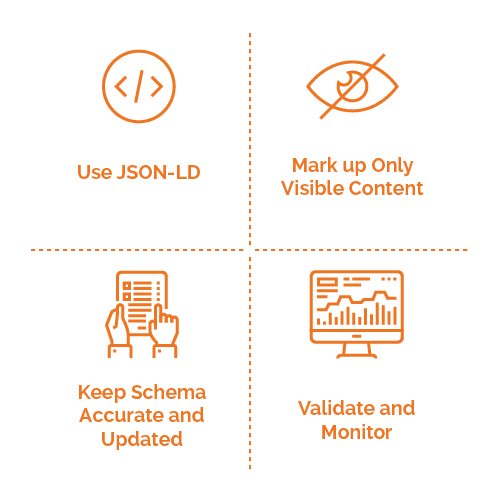
By following these schema markup best practices, you ensure that your content is both trustworthy and eligible for rich features.
Types of Schema Markup That Matter for SEO
Different schema types support different use cases. The most important for SEOs include:
- Article/BlogPosting: Helps Google identify blog and news content, with properties like headline, author, and publish date.
- FAQ/Q&A: Surfaces questions and answers directly in SERPs. While Google reduced FAQ visibility in 2023, it’s still valuable for other engines and AI summaries.
- Product: Critical for eCommerce—includes name, description, price, availability, reviews, and now support for 3D models and product variants.
- Other high-value types: BreadcrumbList (navigation), LocalBusiness (local SEO), Event (date/location details), and VideoObject (video snippets).
Each type supports different search results experiences, and together they increase the chance your content is cited in AI search results contexts.
How to Integrate Schema Markup for AI Search Engines
Implementation requires strategy, not just code snippets:
- Map schema properties to your page: Example: A product page should include Offer details (price, currency, availability) and aggregateRating.
- Use sameAs to reinforce entity links: Connecting to authoritative sources like Wikipedia or LinkedIn helps disambiguate entities.
- Test and adapt: AI search engines evolve quickly. Monitor Google’s guidelines, adjust your schema, and test regularly.
Structured data for AI search isn’t just about rich results. It’s also about ensuring AI can confidently pull your content into generative summaries.
Structuring Content for Generative AI and NLP
While schema markup makes content explicit, NLP-driven structuring ensures that AI understands the implicit meaning of your page.
What Is NLP in SEO and Why It Matters
Natural Language Processing (NLP) powers how search engines interpret text. Google’s BERT and MUM updates shifted indexing from keyword matching to context understanding.
- Entity-based SEO: Google maps pages to “things” (people, places, products) instead of just words.
- Context and salience: The more clearly you reinforce your main entities, the more relevant your content appears.
- User intent alignment: NLP enables Google to match queries with the most semantically relevant search queries, not just exact phrases.
Understanding what NLP is in SEO is critical because it explains why entity-based SEO and semantic SEO techniques now drive visibility.
NLP Techniques for SEO Content That AI Understands
- Clear heading hierarchy: Organize content with H1 → H2 → H3. This gives both users and crawlers a clear roadmap.
- Introduce key entities early: Mention primary topics in the intro and reinforce them throughout.
- Use synonyms and related terms: Semantic SEO techniques expand coverage without keyword stuffing.
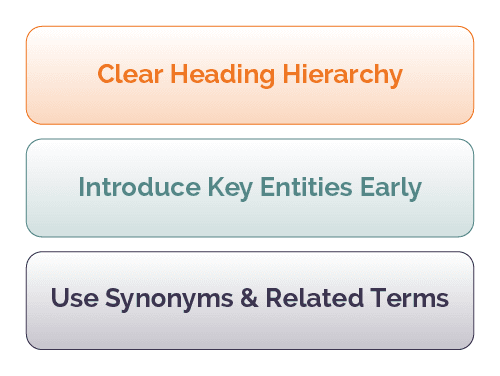
Alt text: Infographic with three boxes reading: Clear heading hierarchy, Introduce key entities early, Use synonyms and related terms.
These NLP techniques for SEO content make it easier for AI search algorithms to identify what your page is about and match it to queries.
Practical Ways to Structure Content for AI Search
- Use lists and bullet points: AI often extracts lists for featured snippets and summaries.
- Include FAQ-style sections: Pose common questions as headings and answer them concisely.
- Leverage semantic HTML tags: <article>, <section>, and <nav> help search engines distinguish content areas.
- Keep content in raw HTML: Avoid hiding key information behind JavaScript. Many AI scrapers don’t render JS, if so, it’s incredibly difficult to render and may negatively impact rankings.
These strategies answer the question of how to structure content for AI search in ways that align with both SEO and AI models. Paying attention to structured formatting also ensures better readability and improved user experience.
AI Search Optimization in Action
Theory is useful, but let’s see how these tactics work in real-world examples:
- Product schema in practice: An eCommerce page with Product + Offer markup, combined with structured headings, is pulled into Google AI Overview for a query like “best budget wireless headphones.”
- FAQ block surfaced in People Also Ask: A health site adds a Q&A section with schema, and one of its concise answers is displayed directly in SERPs.
- Entity-organized article: A blog about electric vehicles structures content around sub-entities (battery life, charging infrastructure, tax credits), building topical authority and improving rankings across entity-driven queries.
These examples show that AI SEO best practices are not hypothetical; they already impact visibility. Updating and reworking existing content with these methods can also expand its reach in new generative contexts.
Future-Proofing Your SEO for AI Search Engines
AI-driven search will continue evolving, and so should your SEO strategy.
- Stay current on schema support: Google continues adding properties (e.g., product variants, 3D models). Implement early for an advantage.
- Double down on entity-based SEO: The more clearly you tie content to entities, the stronger your authority signals.
- Make AI search optimization core to SEO: Don’t treat it as an optional layer. Schema markup and semantic SEO techniques should be part of every content workflow.
By adapting now, you ensure your content remains visible as generative search engines become the standard entry point for users.
Why Schema and NLP are Non-Negotiable for Future SEO
Optimizing content for AI search engines requires balancing explicit and implicit signals. Schema markup provides structured clarity, while NLP-driven content structuring ensures search engines and AI models understand context and relevance. Together, these strategies position your content to earn visibility in AI Overviews, Copilot responses, and beyond.
The future of SEO lies in structured data for AI search and semantic SEO techniques that make content both human-friendly and machine-ready. For SEOs, the takeaway is simple: evolve with AI or risk being left behind.
If you’re ready to put these strategies into action, Zero Gravity Marketing can help. We guide brands through the shift to AI-powered search with proven AI SEO best practices, from structured data implementation to semantic content optimization. Contact us today to start future-proofing your digital strategy.