The world of search is experiencing a sharp shift. With the quick rise of AI tools like ChatGPT, Perplexity, Gemini, and Google AI Overviews and AI Mode, users are no longer limited to scrolling traditional search engine results. Instead, they’re getting direct, conversational answers right where they type their questions. This change has made many marketers ask: is SEO still relevant? And if so, what does optimization look like in a world where AI does the searching for you?
Traditional SEO isn’t gone, but it is evolving. The organic search strategies that once brought consistent traffic and rankings are being tested in real time as AI-generated content and zero-click search experiences become more and more commonplace. Staying visible now means understanding not only how people search, but how machines interpret and present that information.
What You’ll Learn in This Post
This blog breaks down what’s really changing in the world of SEO, and how we can adapt.
You’ll learn:
- How AI tools like ChatGPT and Perplexity are reshaping search behavior
- Why traditional SEO is still useful but must be updated for AI-first search
- What AEO, GEO, and AIO are, and how each one supports AI-driven visibility
- Where traditional SEO continues to perform well
- How to structure a hybrid strategy that supports both AI engines and search engines
- Examples of how brands are being affected by (or adapting to) AI disruption
- Key takeaways for how to future-proof your search visibility
SEO Isn’t Dead, But the Rules Are Changing
Search engine optimization (SEO) has always evolved. What worked in 2000 wouldn’t work in 2010, what worked in 2010 wouldn’t work in 2020, and what worked last year may already be outdated today. AI isn’t killing SEO, but it’s changing its function and purpose.
Instead of the traditional 10 blue links on a Google results page, users are seeing curated summaries, conversational AI results, and answer engines that bypass websites altogether. Search behavior is changing along with the platforms themselves. More and more users want convenience, speed, and precision, and AI tools are being built to deliver exactly that.
This shift underscores the need for modern SEO strategies that address both traditional search engine algorithms and the new logic behind AI-generated results.
For a broader discussion about the long-term viability of SEO, check out our post on whether SEO is dead. This post picks up where that one leaves off, focusing specifically on how artificial intelligence is changing the structure and future of search.
How AI Search Is Disrupting Traditional SEO
Generative Answers Replace Search Clicks
When someone asks a question in ChatGPT or types into Google’s AI Overviews (formerly Search Generative Experience (SGE)), they’re often met with a full answer at the top of the screen. No scrolling, no clicking, no organic result interaction required.
These answers are compiled from multiple sources and presented in a digestible way, and oftentimes without a link or clear citation. While some AI tools like Perplexity do include footnotes, others keep the user fully within the AI interface. This directly impacts organic traffic, especially for sites that used to rely heavily on informative blog content to capture top-of-funnel interest.
This is the new reality of generative search, where summarization often replaces exploration.
The shift isn’t limited to early adopters. Nearly 800 million people use ChatGPT each week, and AI search tools are becoming more and more popular for younger demographics in particular.

Declining Visibility and CTRs
As AI-generated responses increase, the share of organic clicks is decreasing, particularly on queries where a simple answer or summary satisfies the intent. HubSpot recently reported declines in top-of-funnel traffic, noting that much of their educational content is now being paraphrased by generative tools. Publishers and media outlets have experienced similar impacts.
In informational queries like “how to,” “what is,” and “benefits of”, many brands are watching traffic slip away, even if they’re still ranking well in traditional SERPs. In other words, performance may look fine on paper, but user behavior is bypassing the click altogether.
This makes understanding user intent even more critical, as AI tools prioritize precision over broad content exposure.
From SEO to AEO, GEO, and AIO-What’s the Difference?
Rather than asking “Will AI kill SEO?” the better question is: “What is SEO becoming?” That’s where newer frameworks like AEO, GEO, and AIO come in.
These aren’t replacements for SEO, but evolutions of it. Each one reflects how optimization is shifting from human readers to machine interpreters. AI-powered search is fundamentally changing what it means to optimize. It’s not just about being found; it’s about being understood and repurposed correctly by AI systems.
AEO (Answer Engine Optimization)
AEO focuses on helping your content get pulled into AI-generated answers. Keywords still matter, but structure, context, and clarity matter more.
To optimize for AEO:
- Use question-based headings and subheadings
- Keep answers concise and direct (think: 2-3 sentence summaries)
- Include structured content like bullet points, numbered lists, and FAQs
- Add schema to signal definitions, how-to content, and reviews
This format helps both AI interfaces and traditional search engines surface your content when users are asking questions directly.
GEO (Generative Engine Optimization)
GEO goes one layer deeper. Instead of focusing only on visibility in responses, it helps position your content as a source during content generation.
To optimize for GEO:
- Use semantically rich headings that define clear sections
- Write content in a linear, logical structure with minimal fluff
- Clean up code and formatting so AI crawlers can extract meaning
- Avoid over-optimized or bloated language-keep it real, clear, and skimmable
GEO is especially helpful for evergreen content and thought leadership that may influence large language models over time.
AIO (AI Optimization)
AIO combines both approaches and adds additional layers. It considers not just what AI pulls and displays, but also what it trusts, ranks, and repeats.
To optimize for AIO:
- Prioritize factual accuracy and up-to-date references
- Maintain internal consistency in language, linking, and structure
- Use authorship, source credibility, and external validation (e.g., citations)
- Integrate schema beyond the basics-organization, author, product, FAQ, and review
Brands that focus on creating trustworthy content are more likely to earn placement across both search engines and AI-generated outputs.
Per Senior SEO Strategist, Breanna Yashko, “At their core, AEO, GEO, and AIO aren’t entirely new approaches but extensions of what SEO has always aimed to do: help the right audience find the right information in the right format. Whether you’re optimizing for Google or a generative model, the fundamentals still matter. Clear structure, useful content, and technical soundness remain the backbone of effective optimization; it’s just the context that’s shifted.“
Where Traditional SEO Still Wins
With that being said, not everything has changed. In fact, several core SEO principles still apply and some are even more important now than ever.
- Bottom-of-funnel keywords like “[brand] near me” or “buy [product] online” still drive meaningful traffic and conversions
- Local SEO remains highly effective for service businesses and retail locations
- Google Business Profiles continue to appear prominently in results, especially for mobile users
- Technical SEO (site speed, crawlability, security) still supports visibility across platforms
- In-depth content with first-party data or a strong point of view is harder for AI to replace
When paired with smart content optimization practices, traditional SEO techniques still deliver measurable returns.
In these scenarios, optimizing for humans still pays off. AI is unlikely to fully replace search behavior around price comparisons, shopping, booking, or local services anytime soon.
Building an Effective AI-Era SEO Strategy
Combine Traditional SEO with AI Structuring
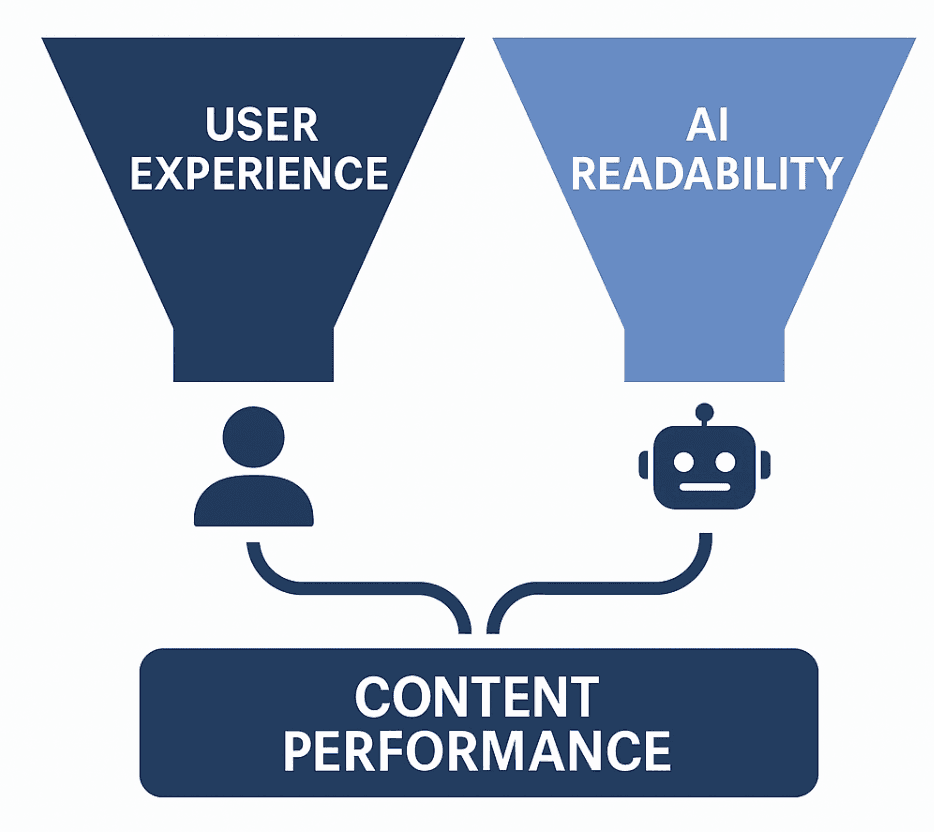
Foundational SEO best practices aren’t going anywhere, but they need reinforcement. Your content should continue to follow keyword strategy, internal linking, and meta tag optimization. But now it also needs to account for:
- Clear Q&A formatting
- Headers that match user questions
- On-page organization that supports AI parsing
- Structured data (FAQPage, HowTo, Product, Review, etc.)
- Semantic variety around keywords to capture broader AI signals
The key is to make your content both user-friendly and machine-readable, all without sacrificing your brand’s voice.
Use AI Tools for Support, Not Substitution
AI writing tools like Jasper, ChatGPT, and Claude can speed up research, outlines, and draft generation. But overreliance leads to sameness, factual inaccuracies, and missed nuance. Use AI to scale but be sure to edit with intention. The best results come when content creation blends automation with human quality control.
Review for:
- Accuracy and citation consistency
- Brand tone and language alignment
- Redundancies or robotic phrasing
- Original insights and human value
When it comes to ranking, quality beats quantity. If your content doesn’t stand out, it won’t go anywhere.
Think Beyond Google
Google may still dominate traditional search, but users are turning to other platforms for information:
- TikTok for recommendations and reviews
- YouTube for walkthroughs and deep dives
- Reddit for authentic discussion
- ChatGPT, Gemini, and Claude for condensed answers and planning
This means your content strategy must account for platform behavior, and your formatting, keyword usage, and tone should flex based on where the content lives and how it’s surfaced. Each platform has its own rhythm, and the job of SEOs and digital marketers is to meet users where they are, in the way they prefer to consume information, to provide the best user experience.
The Winners Will Be the Brands That Adapt
Brands That Don’t Adapt Will Lose Visibility
Traffic losses aren’t hypothetical; they’re already happening across industries that rely heavily on informational content. Media companies, software brands, and aggregators are seeing their content show up in AI-generated answers, but not getting the clicks. When visibility doesn’t lead to engagement, it becomes harder to justify ongoing content investment.
If brands stick to outdated strategies, like publishing high-volume, top-of-funnel content without structure or clarity, they risk becoming invisible in both AI and search-driven experiences.
Brands That Adapt Will Stay Visible
The brands that win in this new landscape will be the ones that adjust quickly. That means restructuring content to be more scannable and useful in AI interfaces, using Q&A formats, and applying schema markup to help machines understand the context.
It also means shifting focus toward content, like middle- and bottom-funnel assets, that support decision-making and where AI is less likely to interfere. Credibility signals like bylines, credentials, and original perspectives will help reinforce trust and increase the likelihood of being cited or summarized.
Tying content efforts to a broader digital marketing strategy helps balance immediate performance with long-term visibility and brand strength.
What This Means for SEO Teams
SEO is a blend of technical skill, content design, and platform-specific knowledge. Teams need to stay sharp on:
- How AI search tools surface and summarize content
- How users behave differently on AI platforms vs. search engines
- What signals machines prioritize (e.g., structure, clarity, credibility)
- Where visibility is happening, even outside traditional SERPs
Rather than focusing solely on rankings, SEOs need to become leaders of digital visibility across AI, search, and social platforms.
AI Hasn’t Killed SEO, But It’s Redrawing the Map
It’s clear SEO has changed, but it’s far from obsolete. The rise of AI-driven search experiences has added complexity and reduced click volume in some areas, but it has also created new spaces for content to gain traction.
Brands that understand how AI interprets, repackages, and distributes information will continue to stand out. SEO success now depends on structure, credibility, and adaptability.
Want help building a strategy designed for AI-first discovery? Contact ZGM to get started.